
Constructive Feedback: Examples and How to Give It

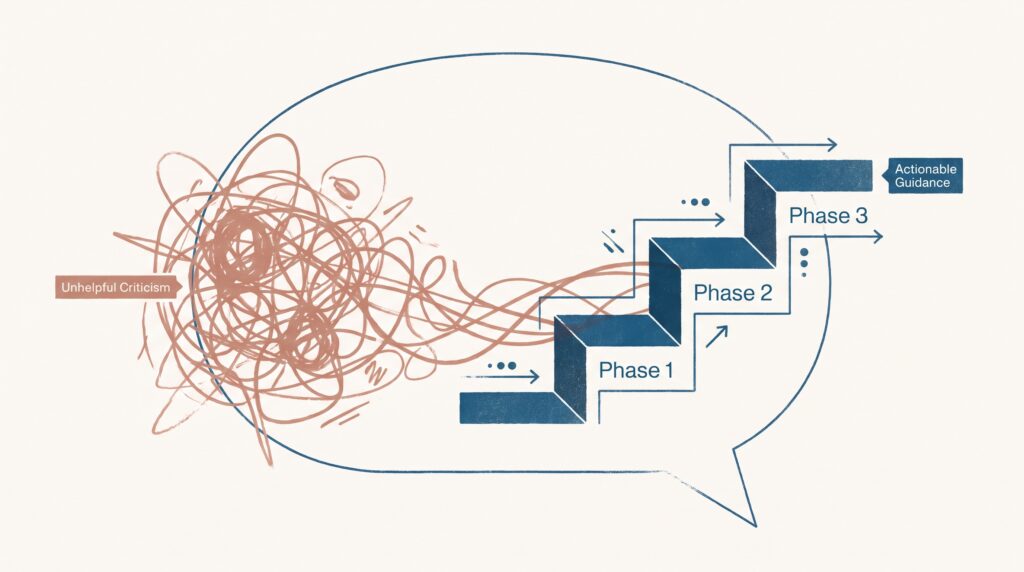
Key takeaway: Constructive feedback is specific, respectful, and actionable input that helps someone improve without reducing them to a mistake. It names an observable behavior, explains its impact, and ends with a next step. This guide covers the definition, how it differs from constructive criticism, how to prepare when you’re stressed or using AI, and word-for-word scripts for employees, peers, and your own boss.
Why Constructive Feedback Is a Leadership Skill, Not a Performance-Review Event
Constructive feedback works best as a frequent leadership habit, not an annual event. Many managers who avoid feedback aren’t indifferent. They’re overloaded, uneasy about conflict, or hoping the annual review will absorb the issue. It rarely does.
Gallup found that 80% of employees who received meaningful feedback in the previous week are fully engaged. Gallup also argues that feedback matters more to engagement than how many days people spend in the office [7]. Employees need timely clarity, not delayed criticism.
Constructive feedback vs. constructive criticism
Feedback that shapes the next attempt vs. criticism that scores the past
| Option | Pros | Cons |
|---|---|---|
| Constructive feedback | Names an observable behavior, explains business impact, can also recognize strengths, and ends with a collaborative next step. | Takes preparation, timing, and emotional regulation; easy to postpone when you are overloaded or conflict-averse. |
| Constructive criticism | Can quickly flag what went wrong when a problem is obvious and urgent. | Usually focuses only on faults, can sound punitive or like a character verdict, and evaluates the past instead of shaping the next attempt. |
Constructive feedback is observable, specific, improvement-oriented, and respectful. It can recognize strengths as well as correct problems. Constructive criticism is the more common phrase, but it focuses only on what’s wrong and can sound punitive when the delivery fixates on blame rather than behavior and solutions. The practical difference is the point of the conversation: criticism evaluates the past, while feedback shapes the next attempt.
What practitioners say about feedback and growth
Common reasons managers stall include worry about damaging relationships, little formal training, and uncertainty about how to balance recognition with correction. Two habits address all three: give feedback close to the event, and anchor it in concrete examples.
As Ash Beckham puts it, “In giving constructive feedback, you offer helpful suggestions that guide someone toward improvement, while also recognizing the things they’re doing well.”
Why Feedback Fear Makes Constructive Feedback Harder Than the Script
Feedback fear is why good scripts fail. Difficult conversations feel socially threatening, so managers wait rather than risk trust or defensiveness.
The hidden cost of waiting for the “right” moment
If a manageable behavior goes unaddressed for months, raising it starts to feel like a character judgment. The employee hears “you are this” instead of “this happened.”
Psychological safety changes the equation. Harvard Business School’s Amy Edmondson has shown that people are more likely to surface problems, admit mistakes, and ask for help when they believe speaking up won’t invite humiliation or retaliation [2].
Employees are also more open to hard feedback than managers assume. In Harvard Business Review’s coverage of Zenger Folkman’s research, 92% of employees said appropriately delivered corrective feedback improves their performance. Respondents also rated corrective feedback as more useful than praise by roughly three to one [3].
So the real question is rarely whether employees can handle feedback. It’s whether leaders deliver it with specificity, respect, and a genuine improvement goal.
Use a three-step reset before a difficult conversation
- Settle your body first. A few slow breaths or a short walk before you start can help you speak more calmly.
- Set an intention. Write one sentence: “My job is to create clarity and support improvement, not to prove that I am right.”
- Check the language. Remove labels like “careless,” “uncommitted,” or “difficult.” Replace them with observable behavior and its impact.
The difference shows up fast:
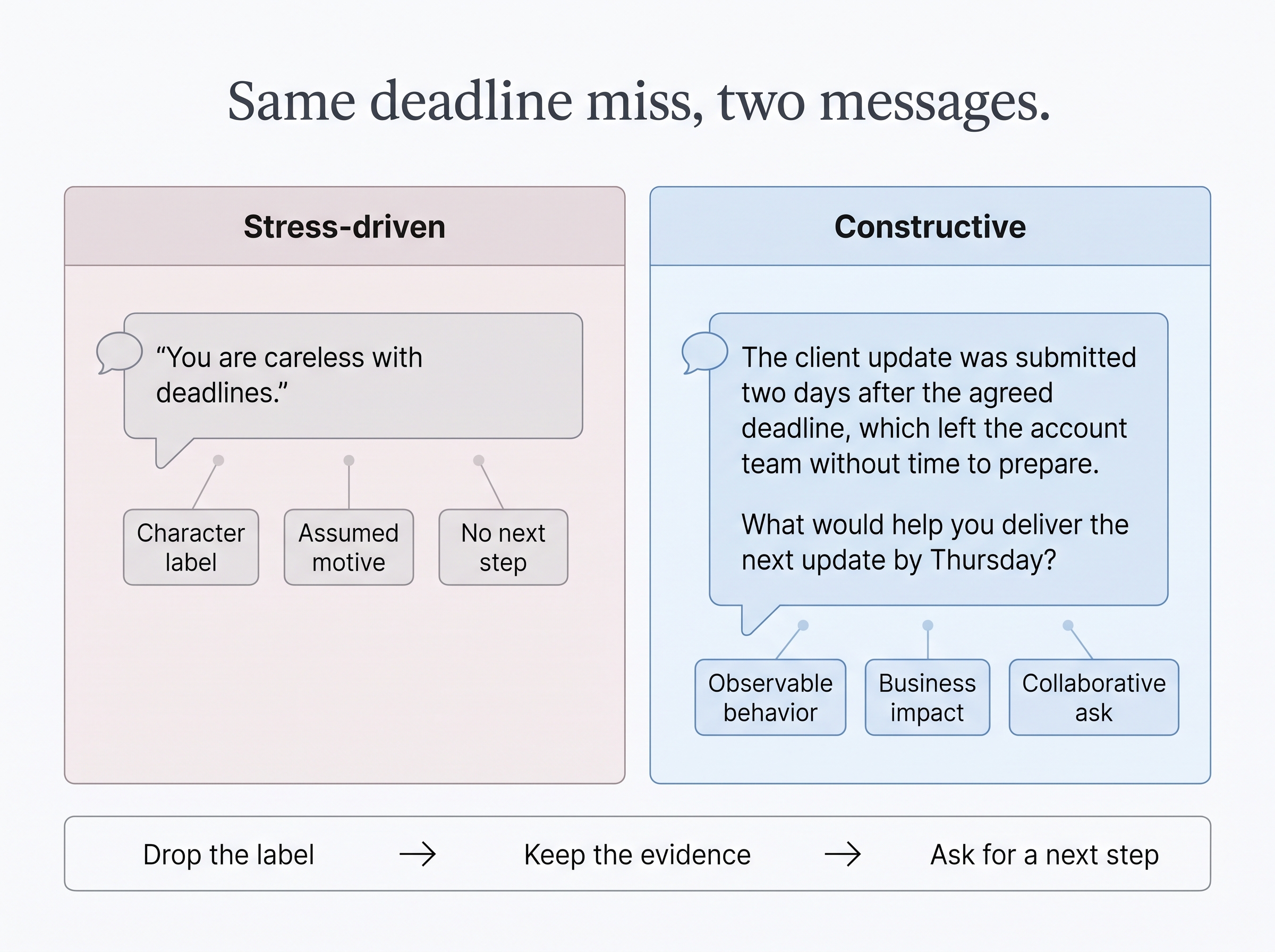
- Stress-driven: “You are careless with deadlines.”
- Constructive: “The client update was submitted two days after the agreed deadline, which left the account team without time to prepare. What would help you deliver the next update by Thursday?”
How to Prepare Constructive Feedback With AI Without Outsourcing Your Judgment
AI can help a manager organize notes, spot vague language, and rehearse a feedback conversation. It should never decide the facts, the employee’s intent, or the final message.
The four-step AI preparation workflow
| Step | Manager action | AI-assisted task | Human guardrail |
|---|---|---|---|
| 1. Gather observations | Collect dated examples, expectations, outcomes | Sort raw notes into themes | Remove hearsay, assumptions, and sensitive personal details |
| 2. Structure the feedback | Identify situation, behavior, and impact | Draft an SBI-format outline | Verify every detail against real events |
| 3. Improve clarity and tone | Check that language is specific and future-focused | Flag vague, one-sided, or personality-based phrases | Stay direct; don’t let AI soften away the real issue |
| 4. Rehearse | Anticipate questions and objections | Role-play the employee, peer, or manager | Listen live and adapt with empathy |
AI handles organization, wording, and rehearsal, while managers stay responsible for accuracy, nuance, and coaching intent [10]. Performance-management guidance also notes that AI can flag vague or one-sided phrasing before it reaches an employee, freeing managers to spend their time coaching instead of drafting [8].
A safe AI prompt example
Act as a feedback-preparation assistant. Do not invent facts or infer intent.
Using the notes below, organize the feedback into Situation, Behavior, Impact,
and a collaborative next step. Flag any wording that sounds vague, personal,
judgmental, or unsupported by evidence.

Notes: [Insert dated, observable work examples only]
Two boundaries matter. First, AI is not for surveillance, scoring employees, or making employment decisions. Second, never paste confidential employee, client, health, compensation, or HR investigation information into a tool your organization hasn’t approved.
How Weekly Feedback Prevents the Annual-Review Pileup
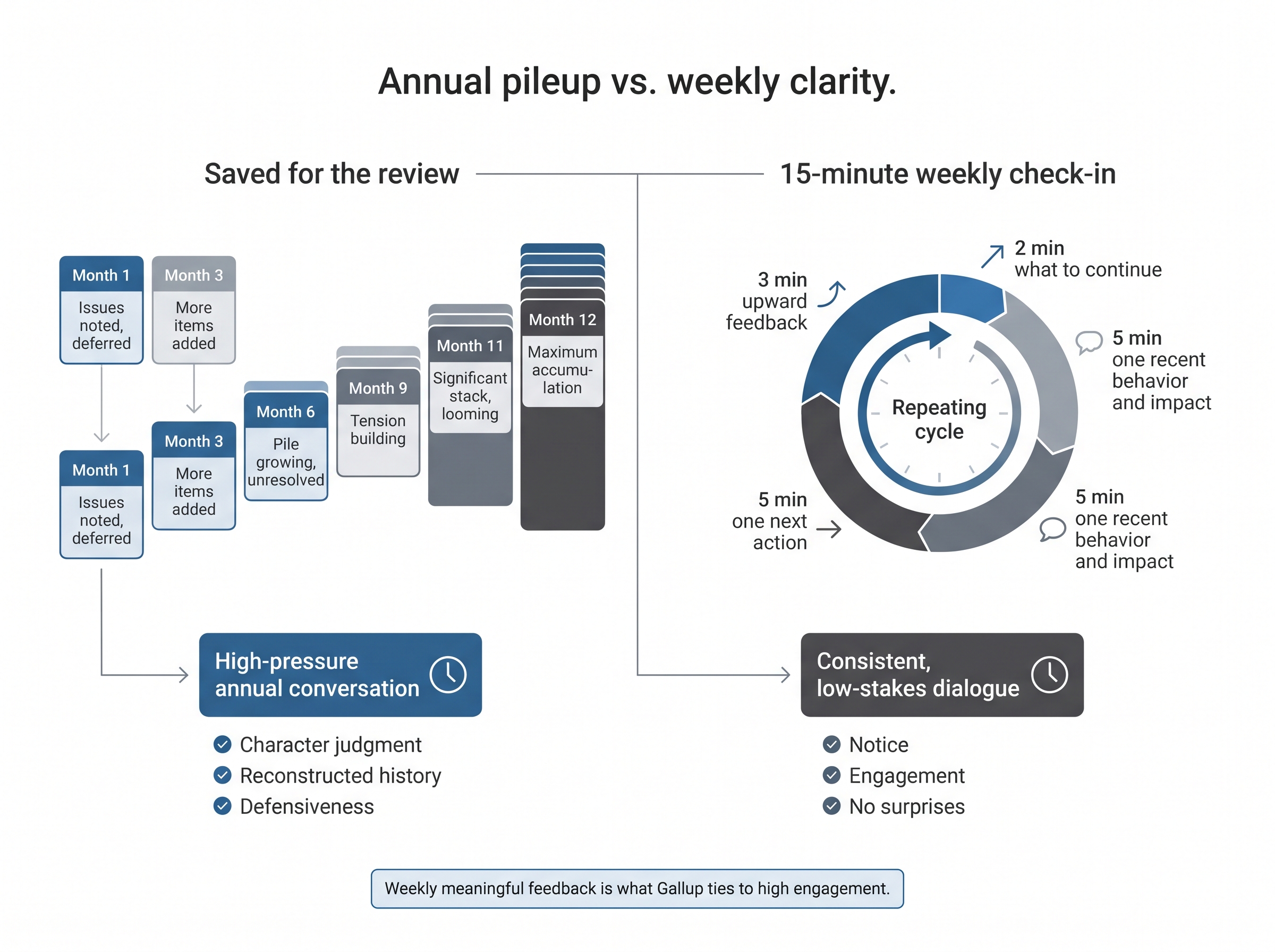
Constructive feedback is far less stressful as a short weekly habit than as months of unresolved concerns delivered at once. That weekly cadence is what Gallup ties to high engagement [7].
Build a 15-minute weekly feedback check-in
- Two minutes: Ask, “What is working well that we should continue?”
- Five minutes: Name one recent behavior or decision and its impact.
- Five minutes: Agree on one next action, resource, or support need.
- Three minutes: Ask the employee for feedback on priorities, obstacles, or your support.
Regular feedback also tells employees their work is noticed and valued, which keeps motivation up between formal reviews [6].
A manager who gives small, timely feedback never has to reconstruct six months of performance history under pressure. One practical habit: spend five minutes before your end-of-week shutdown recording one specific observation per direct report.
Here’s how it sounds: “In Wednesday’s client call, you summarized the implementation risk clearly and gave the client a decision path. That reduced confusion for the team. For the next call, let’s prepare the same kind of decision summary in advance.”
How Overwork Turns Feedback Personal—and How Leaders Can Stop It
Depleted leaders are more likely to use broad, personal, or emotionally charged language, which creates strain instead of improvement. Peer-reviewed research links destructive leadership behaviors to employee emotional exhaustion and burnout [9].
Use the four-sign stress check before delivering corrective feedback
- You are using absolutes: “always,” “never,” “everyone knows.”
- You are assigning motives: “You don’t care,” “You were trying to avoid the work.”
- You are stacking frustrations: one missed deadline becomes a list of every past annoyance.
- You need emotional relief: the conversation feels like venting rather than solving a work problem.
Destructive leadership is not the same as direct feedback. It’s feedback that turns personal, humiliating, inconsistent, or disconnected from any workable next step.
The fix is simple, if unglamorous: pause, narrow the scope, return to evidence, and reschedule if you can’t speak respectfully yet. In her book Workaholic’s Detox, Dr. Kara Larson addresses the cost of overwork, and that lens applies here: treat your own depletion as a signal to pause before a hard conversation. You can start with the free first chapters.
Carol Dweck’s growth-mindset research suggests that people with a fixed view of ability tend to hear feedback as a verdict, while people with a growth view tend to hear it as information for development [4]. Behavior-based wording helps both groups hear the second message.
Constructive Feedback Scripts for Employees, Peers, and Managers
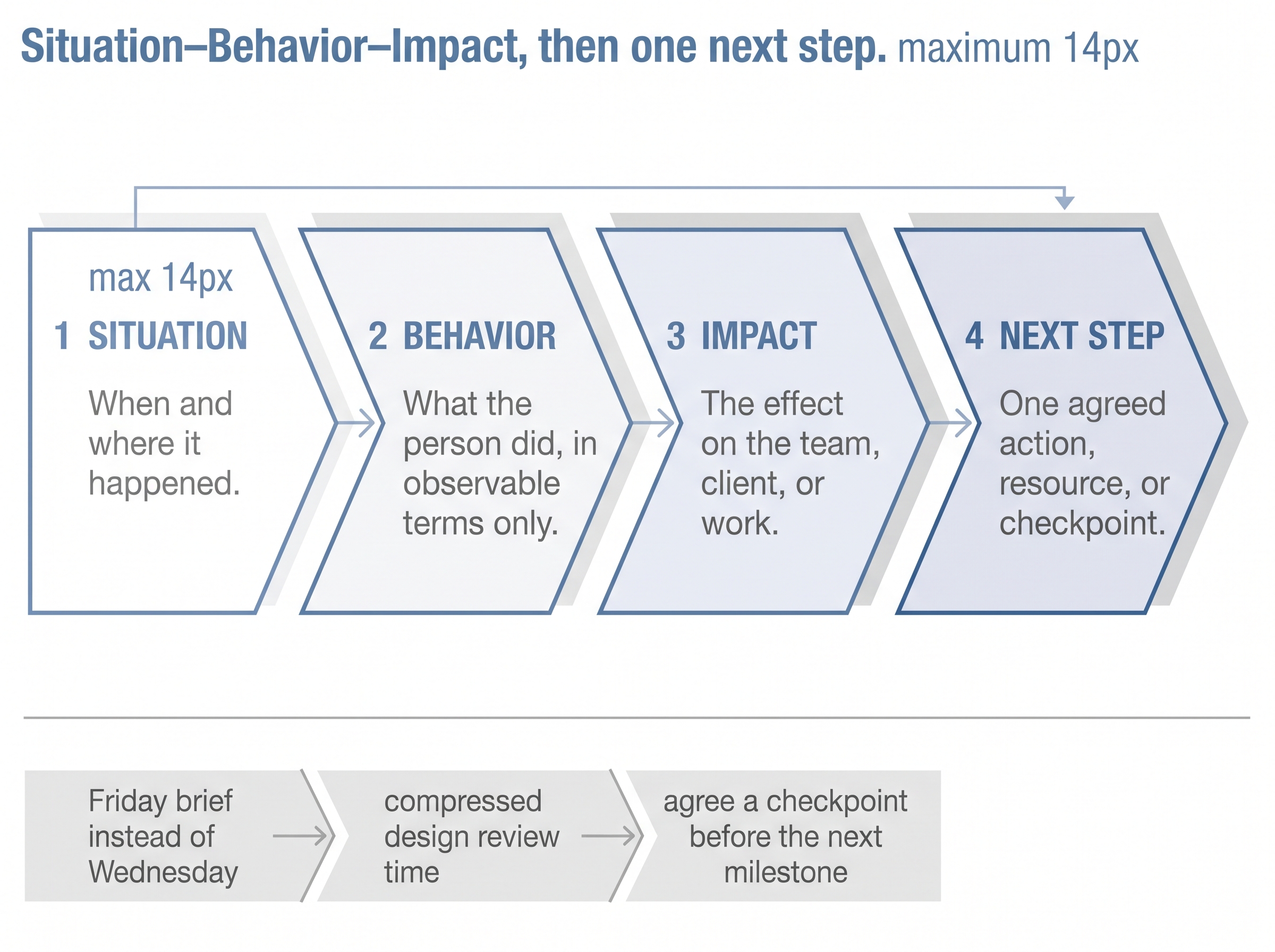
The most reliable scripts combine an observable fact, its impact, and a forward-looking request. The Center for Creative Leadership’s Situation–Behavior–Impact (SBI) model structures this in three parts: the situation (when and where it happened), the behavior (what the person did, in observable terms), and the impact (the effect it had), replacing vague impressions with concrete observations [1].
Ready-to-adapt scripts
| Scenario | Constructive feedback script | Why it works |
|---|---|---|
| Missed deadline | “The project brief came in Friday rather than Wednesday, which compressed the design team’s review time. For the next milestone, what checkpoint would help us stay on schedule?” | Names behavior and impact without assuming intent |
| Strong work | “Your analysis identified two risks the client hadn’t considered, which helped us decide faster. Please keep that level of preparation in future client reviews.” | Positive feedback that is specific and repeatable |
| Peer | “Would you be open to an observation about yesterday’s handoff? The request reached my team without final requirements, so we had to pause. Could we use the checklist before future handoffs?” | Starts with permission and focuses on process |
| Your manager | “Would you be open to feedback on our project meetings? When priorities change near the end, the team leaves unclear about ownership. Could we close with named owners and due dates?” | Respects the power dynamic while staying direct |
| 360-degree review | “One strength you bring is making complex issues understandable. One opportunity is sharing decisions earlier so partners can raise risks before execution.” | Pairs a real strength with a specific development area |
| Interview | “The candidate showed strong technical knowledge, but their examples didn’t demonstrate stakeholder management at this role’s level. I’d advance them only if the next interview tests that directly.” | Keeps hiring feedback job-related and evidence-based |
Keep the structure, swap in real details, and deliver it with curiosity rather than reading it aloud.
Frequently Asked Questions
What are the 5 R’s of feedback?
The 5 R’s are Request, Receive, Reflect, Respond, and Resolve [5]. They cover the receiving side: ask for input, listen without defending, consider what is accurate, respond thoughtfully, and agree on next steps. Managers can model this by asking what leadership changes would help employees succeed.
What is an example of constructive feedback?
A constructive feedback example names a specific behavior, explains its impact, and invites improvement. For instance: “In Monday’s presentation, the data was clear, but the recommendation came at the end, so executives struggled to see the decision needed. Next time, can you lead with the recommendation?”
What type of feedback is detrimental?
Personal, vague, or character-based feedback is detrimental because it attacks identity rather than work behavior. “You’re lazy” or “You’re not leadership material” gives the recipient nothing to act on. Replace labels with specific observations, business impact, and a clear request.
What are three examples of areas for improvement?
Useful improvement areas are observable skills, not personality flaws. Examples include prioritizing deadlines, adapting communication detail for different audiences, and escalating project risks earlier. Each should connect to a recent example, a desired behavior, and the support the manager will provide.
How do I give constructive feedback without damaging the relationship?
Start with respect, describe facts rather than motives, and make the conversation collaborative. Ask permission when appropriate, explain the impact, and invite their perspective before agreeing on a next step. Silence and public criticism damage trust more than timely, respectful clarity.
When should I give feedback, and how do I balance praise with critique?
Give feedback while the details are fresh, but not while either person is emotionally escalated. Deliver it privately when it’s corrective. Don’t use the “praise sandwich” to hide a serious concern; instead, make praise and corrective feedback equally specific and give each its own moment.
When HR, Legal, or Professional Support Is More Appropriate
Routine performance feedback is the wrong channel for some concerns, including allegations of discrimination, harassment, retaliation, threats, safety issues, wage problems, or potential legal violations. Follow your company’s reporting policies and involve HR or legal counsel. Don’t process sensitive investigation materials in AI tools without approved governance. If the same conflict keeps resurfacing despite a clear process, bring in coaching support rather than repeating the conversation louder. And if your own stress feels persistent or unmanageable, consider speaking with a licensed mental-health professional.

Make Constructive Feedback a Sustainable Leadership Practice
Constructive feedback is not a personality trait or a once-a-year ritual. It’s a practice built from four parts:
- Observable facts: use SBI to describe what happened and why it mattered.
- Emotional regulation: run the stress check before you speak.
- Clear next steps: end every conversation with one agreed action.
- Regular conversations: hold a 15-minute weekly check-in instead of saving issues for the annual review.
Done weekly, it reduces surprises, supports engagement, and prevents the resentment that builds when overwork goes unspoken.
If staying calm before the conversation is the hardest part, that skill can be trained. Dr. Kara Larson’s Emotional Excellence course focuses on building emotional regulation for difficult leadership moments.
The goal isn’t to make every conversation easy. It’s to make clarity, respect, and improvement part of how your team works.
About Dr. Kara Larson
Dr. Kara Larson is the author of Workaholic’s Detox. The book explores healthier ways to lead and work without letting overwork define success.
Transparency statement
This article is educational and does not replace HR, legal, employment, or mental-health advice. AI guidance here is limited to preparation and communication support. People, not AI, remain responsible for feedback decisions, accuracy, confidentiality, and follow-through.
References
[1] SBI Model: Situation-Behavior-Impact Feedback Guide | FirstHR
[2] In Tough Times, Psychological Safety Is an Asset, Not a Luxury | Working Knowledge
[3] Constructive Feedback on Performance Review: Examples, Frameworks & 2026 Data
[5] Breaking the Barriers to Feedback: A How-To Guide
[6] Measure the Impact of Continuous Feedback on Performance — TechClass
[7] A Great Manager’s Most Important Habit
[8] Constructive Feedback on Performance Review: Examples, Frameworks & 2026 Data
[10] AI for Performance Reviews: 3 Ways to Prepare Better Feedback
Responses