

Morning Routine for Success: What High Performers Do

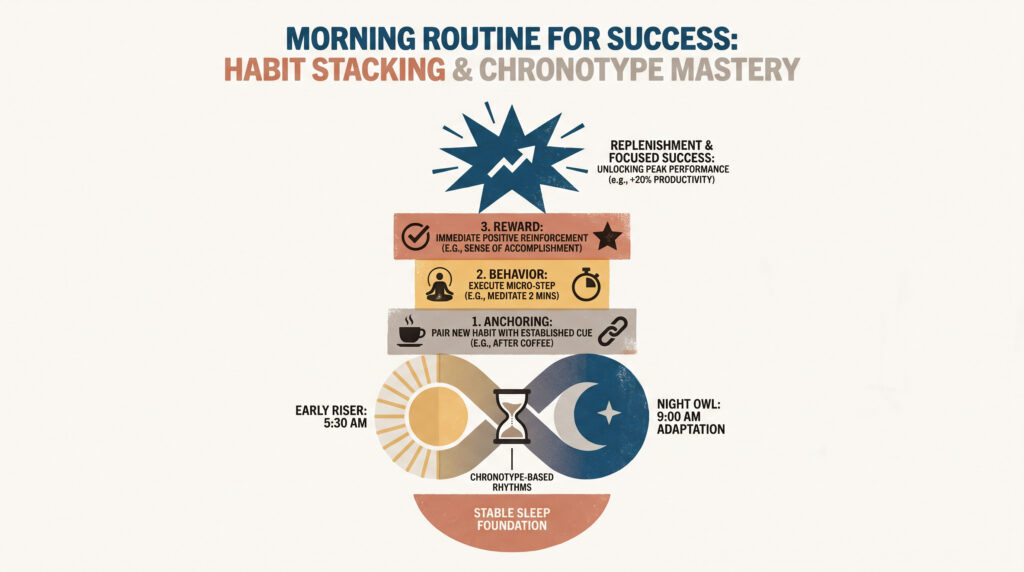
The short answer: A morning routine for success does not require a 4 AM alarm. What holds up is sleep protection, a consistent wake time, digital input kept behind one meaningful task, light movement, and a moment of reflection. Match it to your chronotype, anchor new habits to ones you already have, and treat the morning as replenishment rather than another productivity contest.
Leadership culture decided some time ago that success starts before sunrise: 4:00 AM, ice bath, ninety minutes of deep work before the world stirs. For a US business leader juggling AI implementation, hybrid teams, and a calendar that fills itself, that script does not merely fail. It makes the morning reactive before the workday begins.
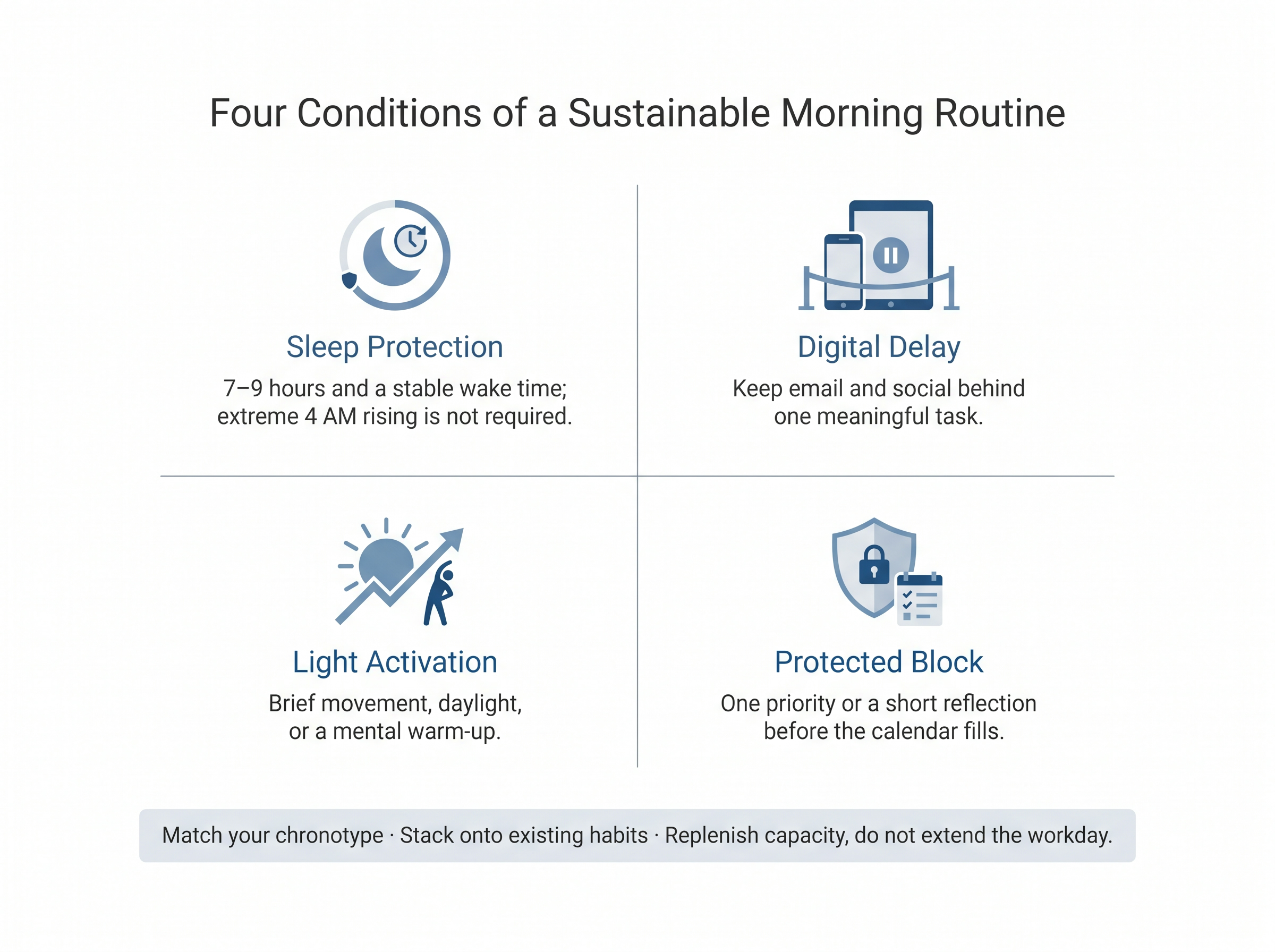
The routines that hold up share four conditions, not a wake-up time: adequate sleep and a stable wake time, reduced digital distraction, physical or mental activation, and protected time for meaningful work or reflection. A good routine raises your capacity without extending your workday. That is the standard applied here to the 4 AM rule, 20/20/20, 5-5-5-30, and Miracle Morning — plus the disputed 90-minute caffeine rule, night-owl adaptations, habit stacking, and burnout prevention, read against sleep, habit, and stress research. It is also the lens Dr. Kara Larson brings to sustainable performance.
What High Performers Actually Say
Practitioners converge on three things — a consistent wake time, quiet before input, and movement — and disagree on nearly everything else. Asana’s 2026 guide catalogs 22 possible morning habits [5]. The people quoted below kept far fewer.
“Getting up at the same time every day is crucial… Once you’re up, the quiet time alone is unmatched.” — Matt Gray, LinkedIn
“Get 7–9 hours of sleep so that waking up at 5 AM is sustainable. Set 3 specific goals that are achievable each day.” — Why Craft the Perfect Morning Routine?, Instagram
Practitioner advice generates hypotheses; it does not prove them. Every recommendation below is checked against sleep, habit, caffeine, and mindfulness research. Engagement numbers are omitted because the supplied social data did not verify them.
The 90-Minute Caffeine Rule: What the Science Actually Says
Delaying caffeine 90–120 minutes after waking is optional, not a requirement. The cortisol-and-adenosine rationale does not survive the strongest available review — though some people do function better with a later first dose.
Claim versus research
A 2024 review in the Journal of the International Society of Sports Nutrition examined that rationale and found it scientifically inaccurate or unsupported (pmc.ncbi.nlm.nih.gov).
| Popular claim | What the evidence indicates |
|---|---|
| Cortisol is too high after waking for caffeine | Cortisol generally peaks within about an hour of waking; waiting does not remove caffeine’s cortisol response |
| Adenosine keeps falling for 90–120 minutes | Adenosine shifts around waking happen within minutes, not hours |
| Early caffeine causes an afternoon crash | No evidence that coffee on waking causes a crash, or that delaying prevents one |
| Everyone should wait 90 minutes | Sleep pressure, tolerance, timing, and health change the answer |
Habitual users around 200 mg daily may show a blunted cortisol response, the review notes.
A practical caffeine decision rule for leaders

Delay caffeine if you slept adequately, if coffee on waking does nothing for you, if waiting lowers your total intake, or if you want to test whether a later dose sharpens alertness. Take it earlier if you are sleep-deprived, if an early meeting demands sharpness, or if waiting pushes you into heavy afternoon consumption.
Huberman Lab still recommends 90–120 minutes (hubermanlab.com); treat that as practitioner guidance, not consensus. If you are pregnant, managing cardiovascular or anxiety concerns, taking interacting medications, or dealing with persistent fatigue, talk to a clinician first.
Night Owl Morning Routines That Work Without a 5 AM Wake-Up
Night owls do not need to force a 5 AM start. A fixed wake time, morning light, and one keystone habit outlast chronic sleep restriction — and light has a dose attached: most experts recommend at least 30 minutes of daylight each morning to establish a sleep-wake cycle [1].
Why extreme early rising can backfire
Moving your alarm earlier without moving your bedtime earlier creates sleep debt. Insufficient sleep is associated with impaired attention, weaker emotional regulation, worse decisions, and higher burnout risk. “Early” is not the same as “effective.”
Even early-rising advocates concede it. Jeff Brown, who posts about his own 4:44 AM schedule, says an unusually early hour is not required for benefit, and recommends starting short (LinkedIn).
The three-step night-owl protocol
- Fix a wake-time range. Stay within roughly 30–60 minutes on most days; avoid dramatic weekend swings.
- Use a light anchor. Get daylight when you can; the Sleep Foundation notes bright-light alternatives such as 10,000-lux therapy lamps when natural light is scarce [1].
- Pick one keystone habit. A 10-minute walk, breathing practice, journaling, or reviewing the day’s single most important outcome. Do not install ten steps in week one.
A sample protocol for a leader who wakes at 7:00 AM:
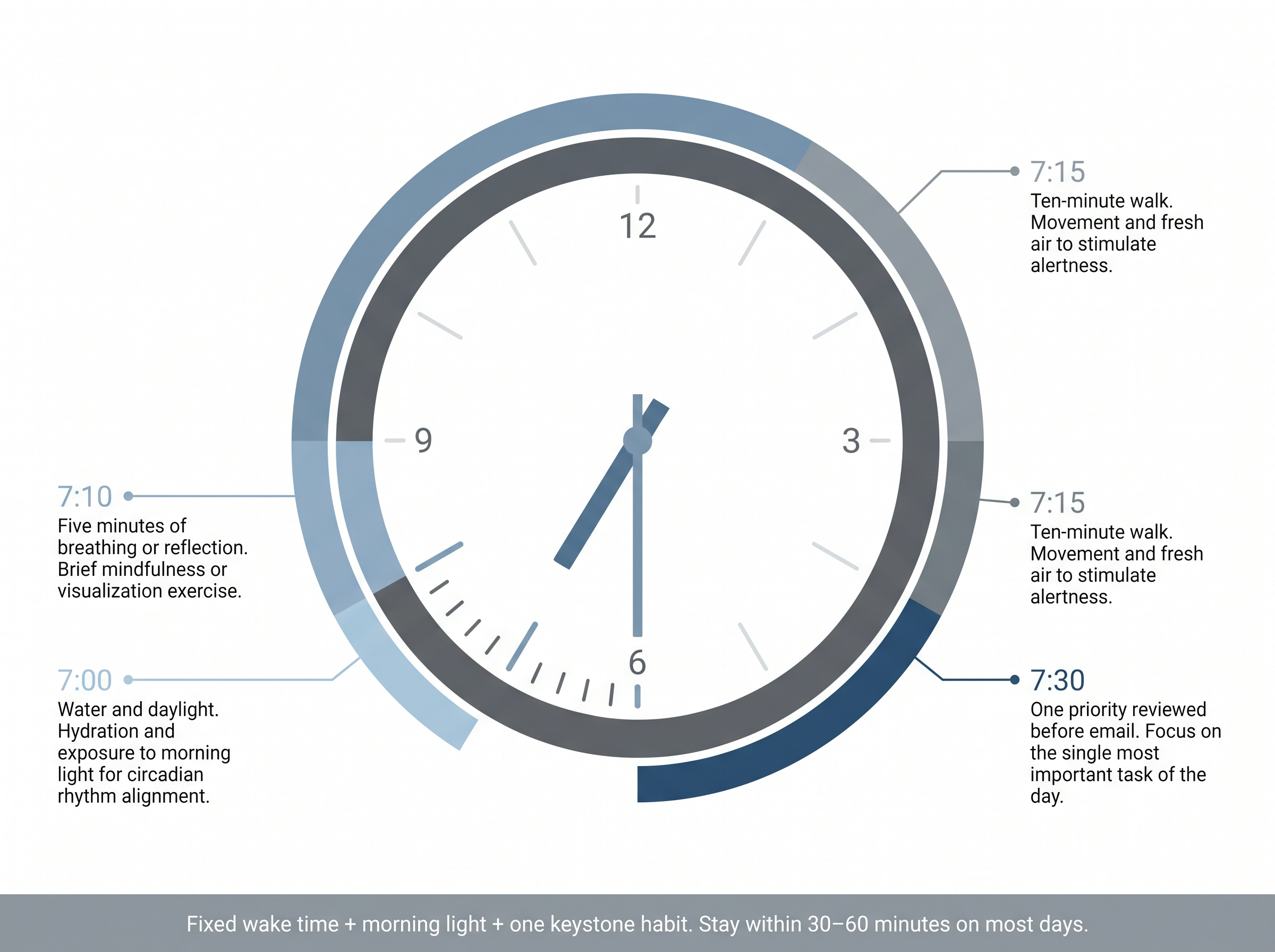
- 7:00 — Water and daylight
- 7:10 — Five minutes of breathing or reflection
- 7:15 — Ten-minute walk
- 7:30 — One priority reviewed before email
Habit Stacking: Anchor New Morning Behaviors to Existing Actions
Habit stacking attaches a new behavior to something you already do automatically — pouring coffee, brushing your teeth, opening the laptop — so the new action rides a trigger instead of your willpower.
The four-step stacking formula
| Step | Guidance | Leader-specific example |
|---|---|---|
| 1. Identify an anchor | A behavior already performed most mornings | After I pour coffee |
| 2. Add one small behavior | Easy enough for a hard morning | I step outside for five minutes |
| 3. State the cue precisely | “After X, I will Y” or “If X, then Y” | If I finish brushing my teeth, then I review my top priority |
| 4. Track consistency | Mark a calendar for 14–30 days | Record whether the walk happened, without grading it |
Stacking uses an existing routine as a reliable trigger [9]. Implementation intentions go further by naming the situation and the action in if-then form; behavioral-design practitioners summarize Peter Gollwitzer’s research as showing stronger follow-through from implementation intentions than from goal intentions alone [10].
Apply the method to movement and the “golden five exercises”
“Golden five exercises” is not one standardized scientific routine. Treat it as a flexible five-movement menu, not a prescription: walking, bodyweight squats, gentle lunges, push-ups or a modified version, and stretching, mobility work, yoga, or tai chi. Choose movements that fit your fitness level and any limitations.
A two-minute walk you actually take beats a 30-minute workout you abandon by Thursday, because behaviors stick when they are easy enough for your worst morning [3]. Morning exercise also tends to be more consistent simply because it happens before competing obligations accumulate [2].
You may see the 66-day habit figure attributed to The 5 AM Club; the number predates the book. It comes from Phillippa Lally’s 2010 research at University College London, which found a median of 66 days to automaticity — with a range of roughly 18 to 254 days depending on the behavior and the person (University of Surrey). A median is not a deadline.
Designing a Morning Routine to Prevent Burnout, Not Cause It
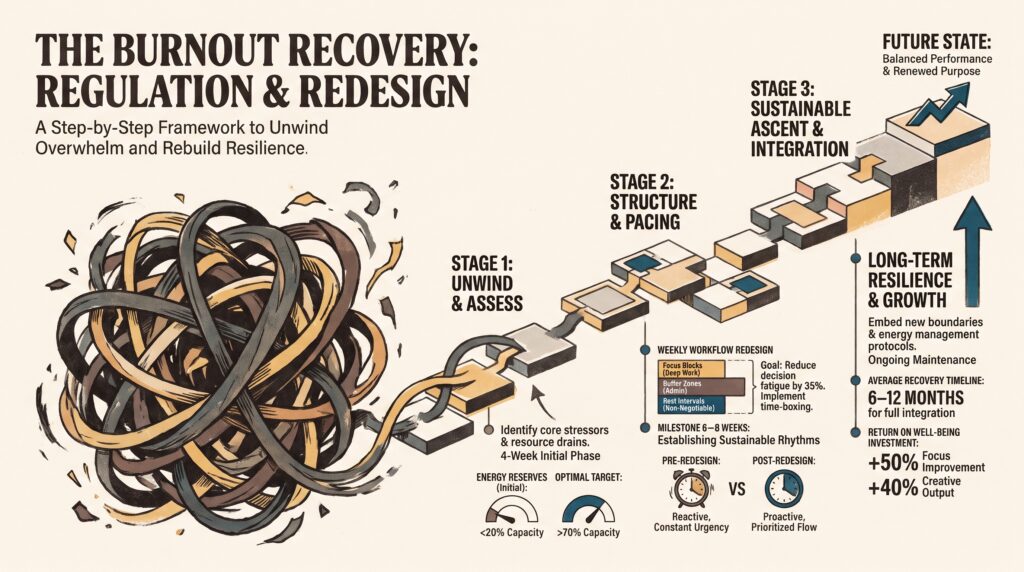
The best morning routine for an overworked leader replenishes before it consumes. It restores attention, steadies emotion, and protects a meaningful first block instead of turning every minute into another performance metric.
Use a replenishment-first design
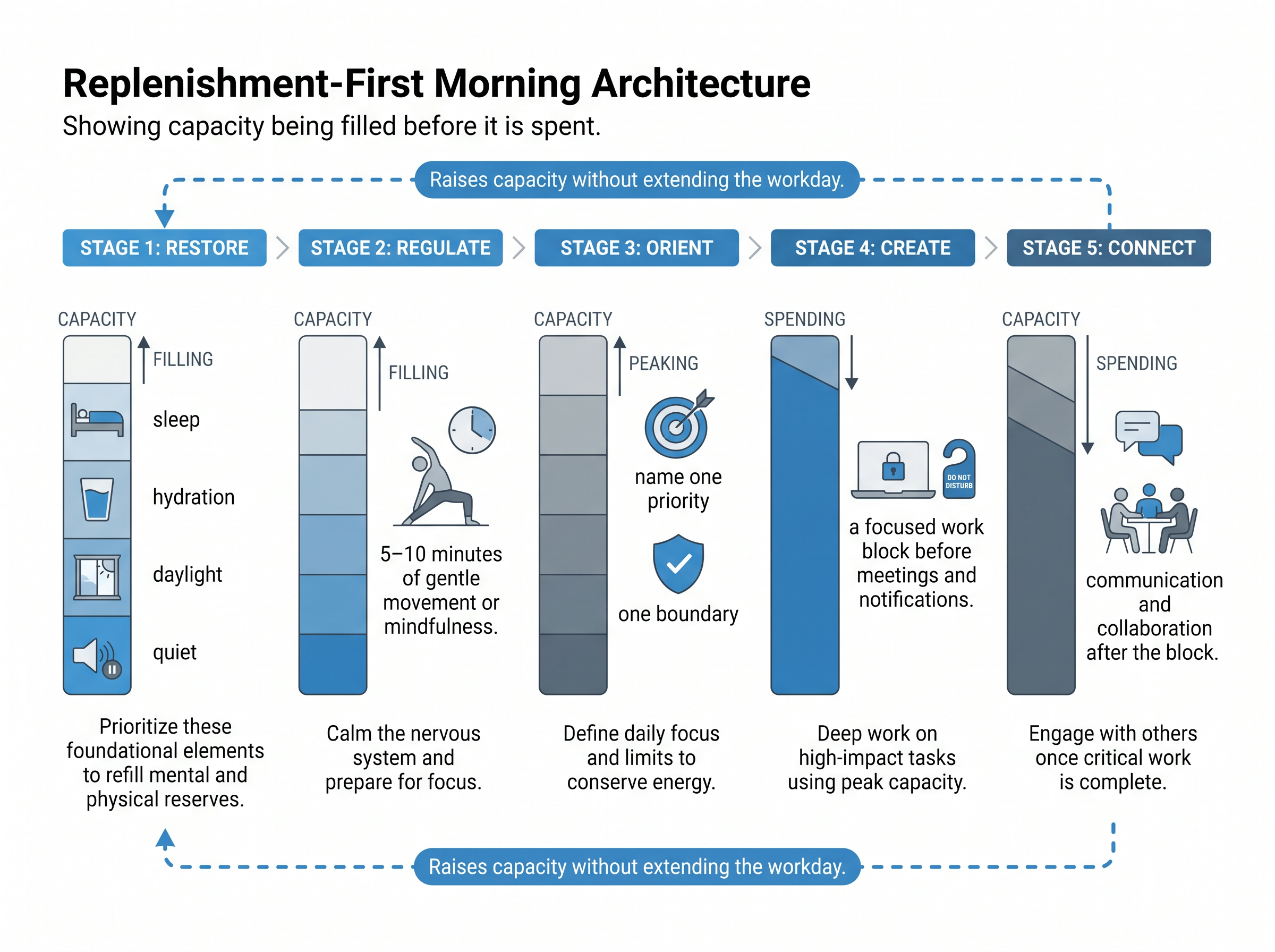
- Restore. Sleep, hydration, daylight, breathing, quiet.
- Regulate. Gentle movement, stretching, walking, yoga, tai chi, or mindfulness — five to ten minutes is enough to reduce stress and sharpen focus for the day ahead [7].
- Orient. Name one priority and one boundary.
- Create. Finish a focused work block before unnecessary meetings or notifications.
- Connect. Move into communication and collaboration after that block.
Vistage recommends identifying replenishing activities and building regular rhythms around them rather than improvising recovery; its 2026 guidance reports that 7 in 10 CEOs experience emotional exhaustion at least occasionally [4]. A burnout-aware morning is a business issue for US leaders, not a wellness luxury.
Decode the named systems without treating them as rules
| System | Structure | Useful element | Limitation |
|---|---|---|---|
| 4 AM rule | Wake at 4:00 AM for quiet or work | Protected time | Sleep debt if bedtime does not move |
| Jeff Bezos’ one-hour rule | A screen-free first hour, with the first meeting at 10:00 AM | Low-pressure transition | One leader’s design, not a protocol |
| 20/20/20 | 20 minutes each of movement, reflection, growth | Balanced first hour | Too long for some leaders |
| 5-5-5-30 | Named routine; steps vary by source | Copyable format | Definitions differ; verify the version you follow |
| Miracle Morning | SAVERS: silence, affirmations, visualization, exercise, reading, scribing | Variety and intentionality | Can become overly elaborate |
The 20/20/20 structure is Robin Sharma’s and the SAVERS sequence Hal Elrod’s [6]. Neither is clinically validated. Even a five-minute routine can create awareness and direction before the day turns reactive [8]. Short and repeatable beats long and impressive.
In Workaholic’s Detox, Dr. Kara Larson examines the patterns that keep overwork in place; a morning routine should interrupt those patterns rather than disguise them as discipline. The free first chapters are available if you want to go further.
Mindfulness evidence is encouraging but bounded: meta-analyses indexed in APA PsycNet, in npj Mental Health Research, and on PubMed Central link mindfulness-based programs to lower perceived stress and better work outcomes, and possibly to cortisol regulation. It does not replace medical or psychological care.
Limitations, Alternatives, and Professional Guidance
Morning routines cannot compensate for chronic sleep deprivation, untreated anxiety or depression, sleep disorders, excessive workload, or an unsafe workplace. Persistent fatigue, insomnia, panic symptoms, or major mood changes warrant a qualified healthcare professional — as does changing caffeine intake, training load, or light exposure while pregnant or managing a cardiac condition. Alternatives exist: a midday reset for shift workers and late chronotypes, an evening routine for parents and caregivers, and a two-minute “minimum viable routine” for travel or crisis weeks.
FAQ
What are some morning rituals that successful people do?
A consistent wake time, movement, reflection, priority-setting, and protected focus time. The clock time matters less than whether the routine protects sleep and reduces reactive phone use. The test is whether it repeats on an ordinary Tuesday.
What is the 4:00 AM rule?
A productivity idea that recommends waking at 4:00 AM to gain quiet time before other people start working. It is not a scientifically required wake time; if it cuts your sleep, it undermines concentration, mood, and health. Keep the principle — protected personal time — on a schedule that preserves adequate sleep.
What is Jeff Bezos’ one-hour morning rule?
It usually refers to Bezos keeping his first hour free of screens, not to a ban on decisions or meetings. Separately, Bezos has said he holds his first meeting at 10:00 AM and reserves demanding meetings for before lunch (Lex Fridman transcript). Treat both as one leader’s design, not a rule for yours.
What is the 5-5-5-30 morning routine?
A named framework whose exact steps differ by source, so check the version you intend to follow. Assess each element for feasibility, and avoid treating it as evidence-based unless a primary source defines it.
What is the 20/20/20 morning routine?
The first hour split into 20 minutes of movement, 20 of reflection, and 20 of learning, associated with Robin Sharma’s The 5 AM Club. Blocks can shrink to five minutes each while keeping the sequence, and the structure is a planning tool — not an argument for a 5:00 AM wake-up.
What are the golden five exercises?
There is no universally accepted scientific list by that name. A reasonable general menu is walking, squats, lunges, push-ups or modified push-ups, and gentle mobility work. Match selection to fitness level, injury history, and medical guidance.
Conclusion
A morning routine for success is defined by sustainability, not an extreme wake-up time. The leaders who benefit most are not the ones who rise earliest. They are the ones whose routines still exist in March.
Four principles carry most of the weight. Protect sleep and hold a consistent wake time. Treat the 90-minute caffeine rule as optional. Adapt to your chronotype and use morning light. Build habits through anchors and implementation intentions rather than motivation.
Then reframe the project as burnout prevention. Begin with replenishment. Delay unnecessary digital input. Protect one meaningful focus block. And stop measuring the day by how early it started.
If you want a guided structure, explore Dr. Larson’s Morning Routines course.
About the Author
We’re the Dr. Kara Larson team. We write about what we know best, aiming to explain it clearly and help you decide with information you can trust. Our focus is AI-enabled leadership, sustainable productivity, emotional resilience, and work-life balance. Dr. Kara Larson is the author of Workaholic’s Detox and develops practical resources for leaders who want high performance without chronic overwork.
Transparency Statement
This article cites the Sleep Foundation, Vistage, the Journal of the International Society of Sports Nutrition via PubMed Central, Huberman Lab, the University of Surrey, the Lex Fridman Podcast transcript, Sue Behavioural Design, Asana, Leaders Adapt, LinkedIn, and Instagram. Social posts are used as practitioner experience and community context, not as substitutes for peer-reviewed evidence. Engagement numbers are not reported where the supplied data did not verify them. Mindfulness meta-analyses from APA PsycNet, npj Mental Health Research, and PubMed Central are named without links because their live pages could not be fully verified at publication time.
References
[1] How to Wake Up Without an Alarm: 8 Science-Backed Tips
[2] What makes a habit stick? – Mayo Clinic Press
[3] Morning Routine Science: What Actually Sets Up a Good Day
[4] CEO Burnout Recovery: How Leaders Rebuild | Vistage
[5] Best morning routine: 22 habits for a productive day [2026] • Asana
[6] The Miracle Morning Changed My Life | Hal Elrod’s SAVERS Framework
[7] Morning Routines of Successful Business Owners (And How to Create Your Own)
[8] The 5-Minute Daily Leadership Routine That Replaces Hours

Responses