

Time Management Tips and Skills That Actually Work

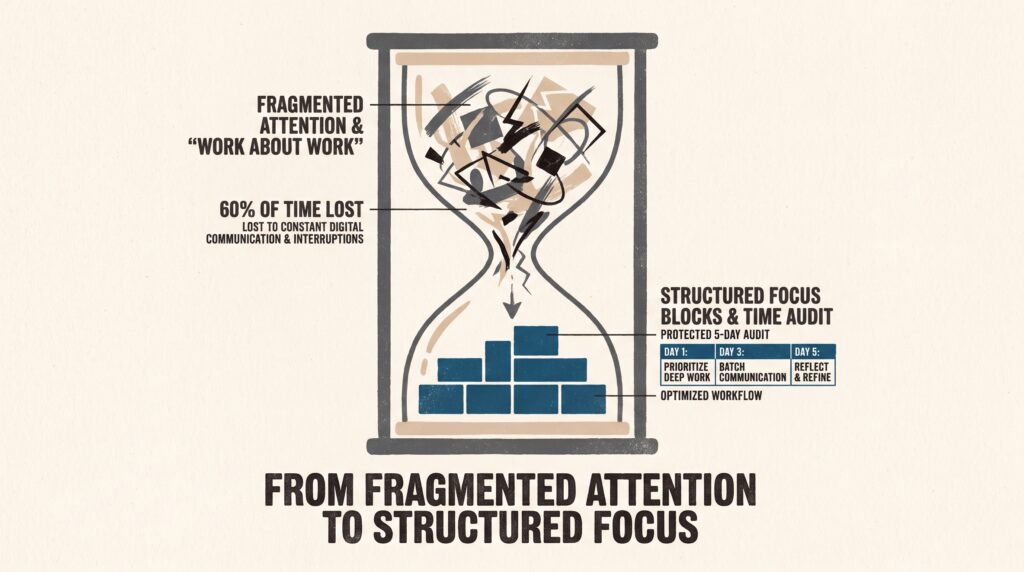
The most effective time management tips do more than fit extra work into the day. They show where your time actually goes, protect focused work, reduce unnecessary communication, and set boundaries so overwork does not fill every gap.
Key takeaway: Start with a five-day time audit. Choose one method that matches your real problem. Schedule focus blocks you can defend, and end each workday with a shutdown routine. If a system raises your stress instead of your clarity, fix the workload before you change the technique.
For US business owners, managers, and corporate leaders, the problem is rarely speed. It is fragmented attention: too many meetings, constant digital communication, and priorities nobody has stated out loud. Workplace analyses drawing on Asana survey data suggest knowledge workers may spend roughly 60% of their time on “work about work”. That means coordination, status updates, and administration rather than the skilled work they were hired to do.
This guide covers:
- Why common advice often fails
- An audit for finding misallocated time
- The link between time management and burnout
- How to match methods to situations
- Answers to six common questions
One caveat: several benchmarks below come from global rather than US-only samples, so treat the numbers as directional.
What practitioners are saying
Practitioners on LinkedIn keep returning to two habits: a few minutes of daily reflection, and a tiny first step that breaks procrastination. These are field observations, not controlled evidence.
“Create daily space for reflection, even ten quiet minutes. Clear thinking often emerges when the mind slows down.” — Eric Partaker, LinkedIn
“The 2-Minute Rule – If it takes less than 2 minutes, do it right away.” — Artem Kalugin, LinkedIn
“Just Start Rule: When procrastinating, commit to just 2 minutes of a task—momentum usually follows.” — Josh Kadrmas, LinkedIn
These rules assume the day contains gaps worth reclaiming. For many leaders, it does not. Small rules help at the margins, but they cannot rescue a calendar that has no margins left.
Why common time management training often fails
Time management training can improve clarity and reduce worry. It does not reliably improve workplace performance. A technique fails when it is added to an overloaded role without changing priorities, interruptions, authority, or workload expectations.
What generic advice usually says
- Planning and prioritizing improve productivity.
- Time blocking creates structure.
- Training employees in time management solves inefficiency.
- Better individual habits automatically produce better performance.
What the evidence shows
A systematic review of workplace time management interventions found stronger effects in academic settings than in workplaces. Two studies found no significant relationship between time management training and performance at all [2].
Macan’s 1996 study makes this concrete. Employees at a social service agency went through a time management intervention, and some attended a two-day seminar. The expected improvement in time management behavior did not appear, as a learning-science analysis of the research describes. The lesson is not that planning is useless. A short course simply cannot overcome structural overload.
The same review cites van Eerde’s finding that training may reduce worry even when performance effects stay limited [2]. If your real problem is anxiety about an uncontrolled workload, that calming effect has value. Just do not mistake feeling better for working differently.
Practical implication for leaders
⚠️ Feeling calmer is not the same as performing better
Workplace time-management training shows stronger effects in academic settings than in jobs, and some studies found no performance gain at all. It may still reduce worry about an uncontrolled workload. Treat that calming effect as a signal to cut commitments, convert meetings to async, and reset response-time expectations—not as proof the technique worked.
Before adopting another productivity system, ask:
- Which commitments can be removed?
- Which meetings can become asynchronous?
- Which decisions genuinely require you?
- Which response-time expectations create unnecessary interruptions?
- Which boundary will make the new system sustainable?
The first step is not choosing the perfect app. It is measuring the work that fills your day.
Where your time really goes: a five-day benchmark audit
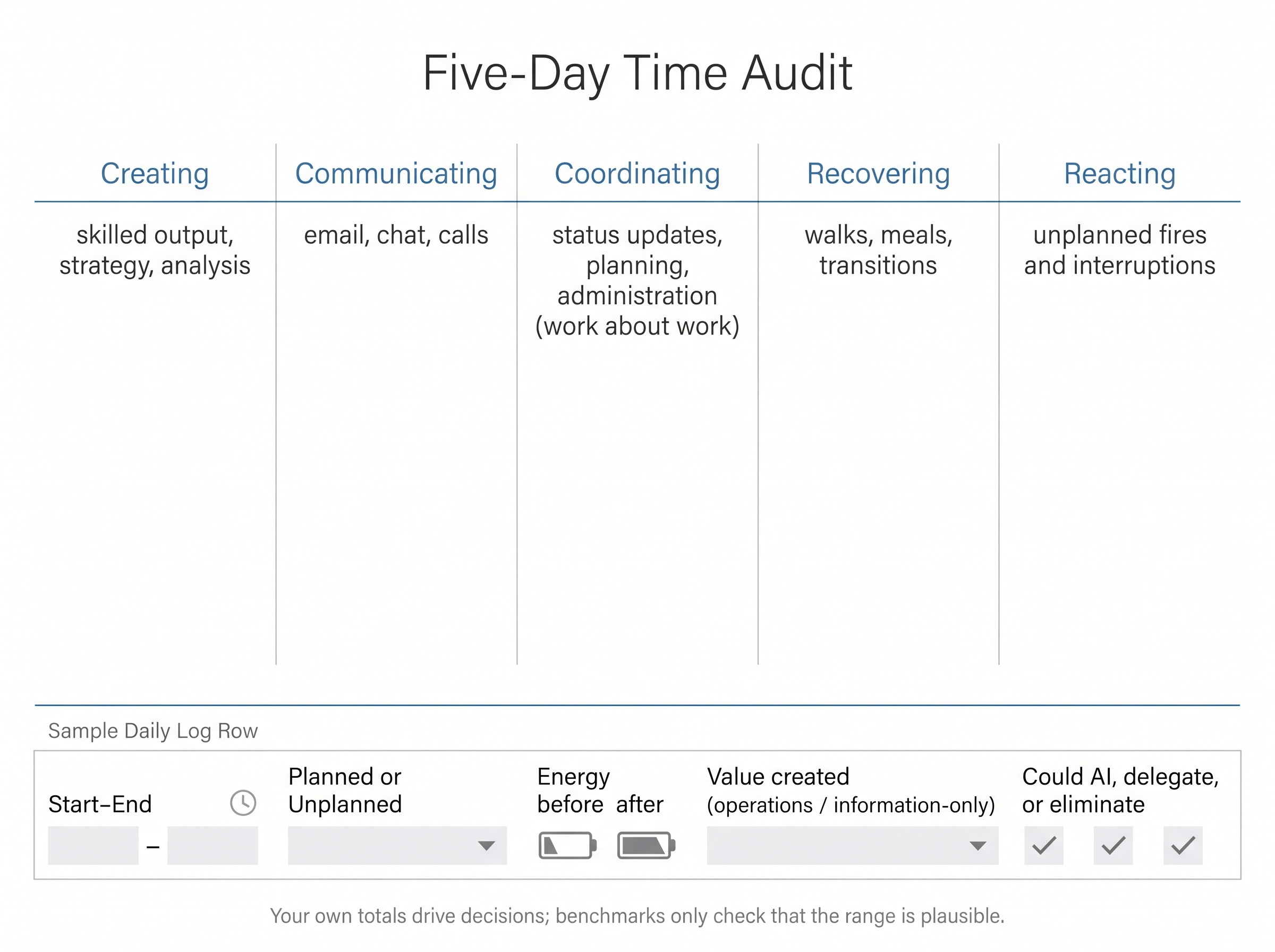
Track five working days across five categories: creating, communicating, coordinating, recovering, and reacting. Then compare your totals with published benchmarks. Treat those benchmarks as context, not as a judgment of your competence.
Benchmark table
| Workplace activity | Reported benchmark | How to interpret it |
|---|---|---|
| “Work about work” | About 60% of knowledge-worker time | Coordination, status updates, planning, administration |
| Communication vs. creation | 57% communication, 43% creation (Microsoft Work Trend Index, 2023) | Useful historically; later editions report different metrics |
| Teams meetings and calls | 192% increase since February 2020 | Digital coordination expanded sharply with remote work |
| CEO meetings | 37+ meetings per week; about 72% of the workweek in one estimate | A warning sign, not a universal average |
Secondary analyses of Microsoft and Asana data support the first three rows. The CEO figure comes from a meeting-productivity compilation, with context from a productivity statistics roundup.
How to run the audit
For each activity, record:
- Start and end time
- Activity category
- Whether it was planned or unplanned
- Your energy before and after
- Whether it created value, kept operations running, or only moved information
- Whether AI, delegation, or elimination could shrink it
At the end of the week, calculate:
- Your share of time in meetings
- Hours spent answering messages
- Hours of uninterrupted strategic work
- Number of context switches
- Work finished after your intended end of day
A note on the benchmarks: the Asana- and Microsoft-derived figures do not all come from US-only samples. Let your own audit drive decisions. Use the benchmarks only to check whether your numbers fall in a plausible range.
Time management without burnout: protect energy, not just hours
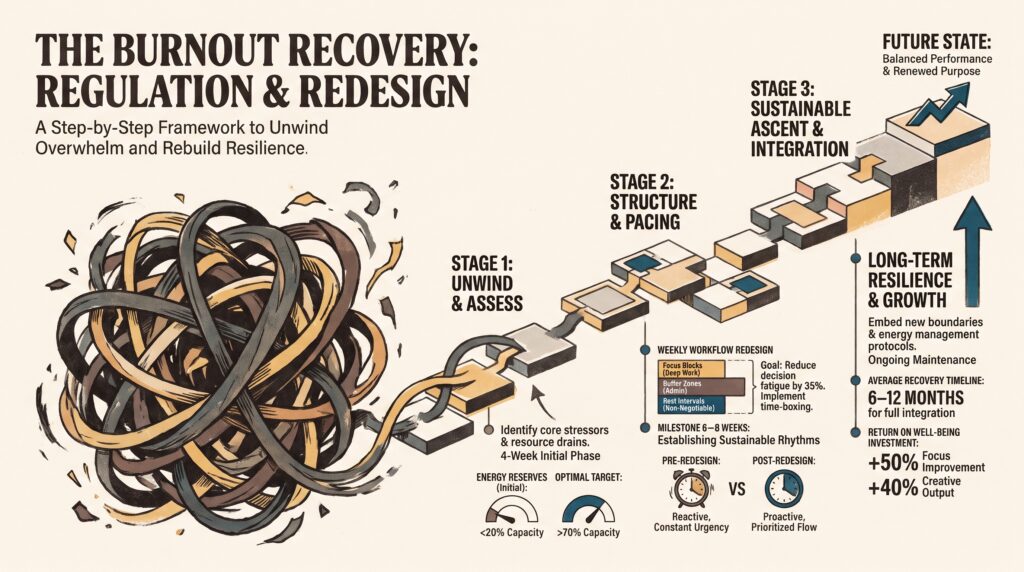
A sustainable system limits mental overload, makes room for recovery, and defines when work ends. The goal is not to fill every hour. It is reliable performance within healthy boundaries.
Build a burnout-aware daily structure
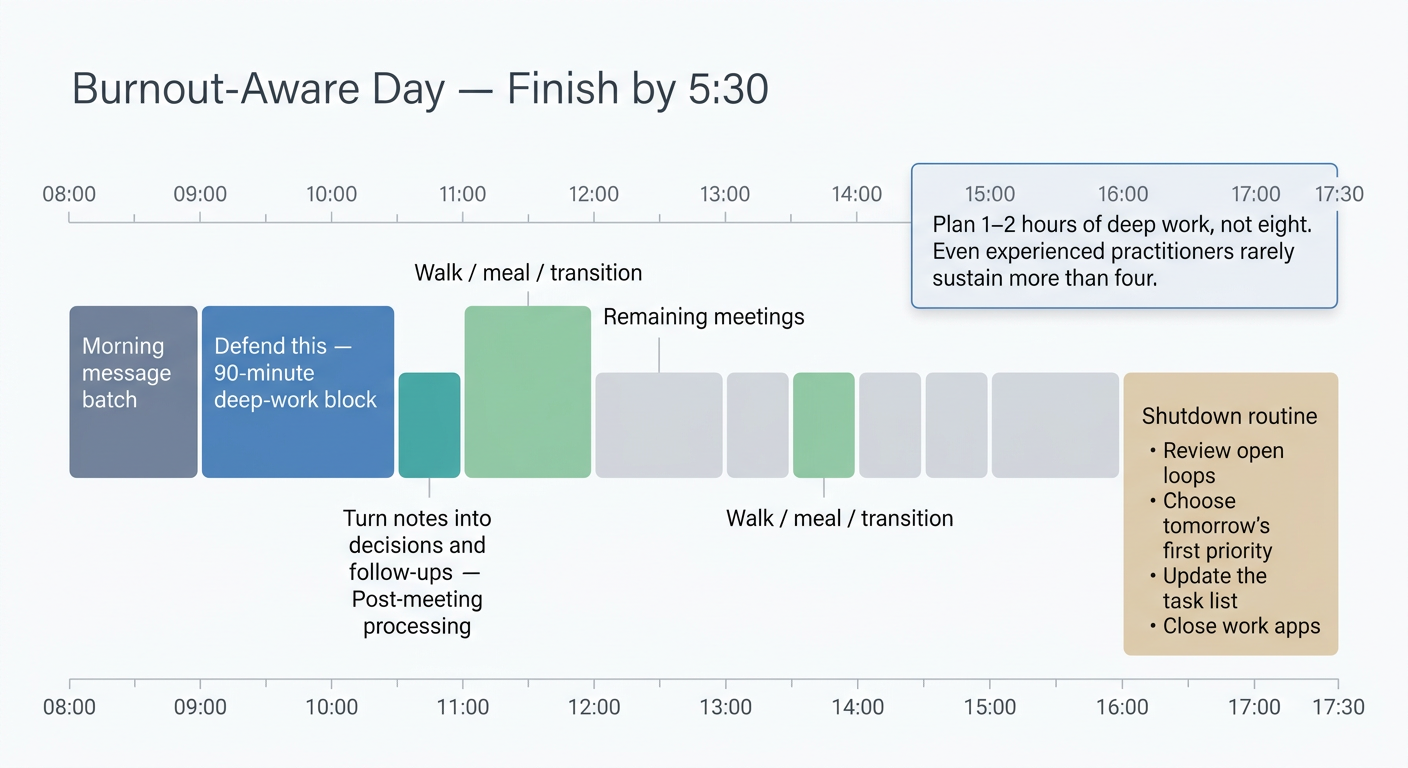
- Schedule one deep-work block you can actually protect. Start with a single 90-minute block. Practitioner analysis notes that even this much is hard to protect in an open office with meetings, interruptions, and demands from above [4].
- Add a processing block after major meetings. Reserve 15 to 30 minutes to turn notes into decisions, tasks, delegated actions, and follow-ups. Analyses of time blocking describe this as the step that keeps one meeting from fragmenting the rest of the day [5].
- Create a shutdown routine. Review open loops, choose tomorrow’s first priority, update your task list, and close work applications.
- Track stress triggers. Log recurring pressure points, such as unclear ownership, urgent messages, stacked meetings, and late-day decision fatigue. Mental health experts cited by the American Psychological Association note that tracking your experiences helps you spot recurring patterns and build a more targeted action plan [1].
- Protect short recovery breaks. Short walks, breathing exercises, meals away from the screen, and transition time between demanding tasks all count.
Fixed-schedule productivity
Try a “finish by 5:30” boundary. Decide when your workday ends, then work backward to decide what deserves the available time. Treat extra work as a deliberate exception, not the default. Summaries of Cal Newport’s fixed-schedule approach describe this method: set a hard cap, then fit the work that matters inside it [6].
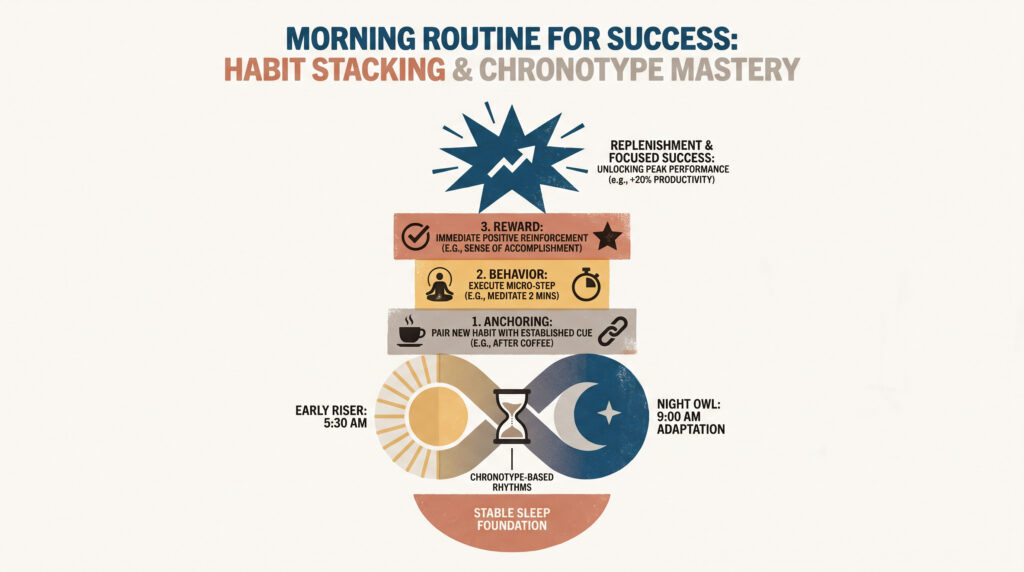
Be honest about your capacity for deep work. Practitioner analysis suggests one to two hours a day is realistic for most knowledge workers, and even experienced practitioners rarely sustain more than four [4]. Planning eight hours of focus sets you up to fail.
In her book Workaholic’s Detox, Dr. Kara Larson examines the relationship between overwork, productivity, and the boundaries that make recovery possible. The free first chapters are available if you recognize yourself in this section.
Match the method to the situation
The best method depends on the problem in front of you. Use prioritization when demands exceed capacity, and lightweight planning when days are chaotic. Use focus intervals when attention is hard to hold, and a review system when tasks keep slipping through the cracks.
Scenario-to-method table
| Situation | Recommended method | How to implement it | Limitation |
|---|---|---|---|
| Calendar controlled by clients, executives, or emergencies | Eisenhower Matrix | Separate urgent from important; delegate or drop low-value work | Does not give you more control over your calendar |
| Every day changes unexpectedly | 1-3-5 method | One major task, three medium, five small | Needs adjusting on meeting-heavy days |
| Starting is hard or attention is fragmented | Pomodoro | Focus on one task for a set interval, then take a short break; adapt the interval to your role | A timer cannot fix unclear priorities |
| Tasks piling up across projects | GTD-style system | Capture commitments, define next actions, do a weekly review | Breaks down when the review is skipped |
| Communication crowding out focused work | Time blocking | Protect focus hours; batch messages into set windows | Requires agreement from your team |
Diagnose the situation first and pick the matching method. Start with the smallest version, and keep the limitation in mind. That way you will not blame yourself when a method cannot fix a structural problem. These pairings align with published guidance on choosing methods [10].
Two failure patterns deserve attention:
- GTD breaks down when the weekly review is skipped. Practitioner guides call this the most common failure point. They suggest tying the review to an existing habit, such as Sunday morning coffee [7]. GTD also only works when calendar appointments stay separate from next actions and multi-step projects [8].
- Prioritization tools need a review rhythm. Tools like the Eisenhower Matrix work best alongside a regular review of your schedule [9].
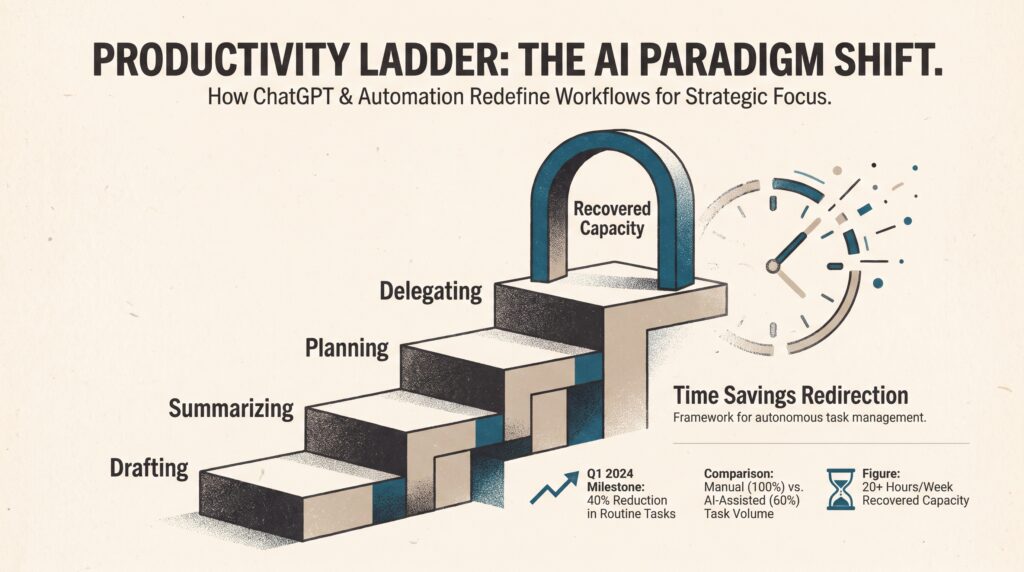
Administrative friction is one more lever. Google Cloud’s case studies show organizations using AI assistants to help employees find information faster. Bank of New York Mellon, for example, did this with an internal virtual assistant [3]. Less time searching means more time for real work.
If fragmented attention is a constant struggle, a Pomodoro timer may help, but it does not explain the cause. Persistent focus difficulties deserve an assessment by a qualified professional rather than self-diagnosis.
Frequently asked questions
How do I track my time?
Track five working days using categories such as focused work, meetings, email, messaging, administration, and recovery. Note whether each activity was planned or unplanned, and record your energy level. At the end of the week, look for recurring interruptions, low-value commitments, and the hours when you do your best work. A spreadsheet is enough. Accuracy and consistency matter more than the tool.
What are the seven key elements of time management?
The seven elements usually cited are goal-setting, prioritization, planning, scheduling, focus and boundaries, delegation, and review. No official body publishes a standard list. These elements work together: goals define what matters, prioritization ranks demands, scheduling assigns time, boundaries protect execution, delegation spreads responsibility, and review corrects the system. For leaders, boundaries matter most, because personal organization cannot keep up with unlimited demand.
What is the 7-8-9 rule of time management?
The “7-8-9 rule” is not a standardized framework. Different websites use the phrase for different daily or weekly routines, so check the specific version before adopting it. A more reliable approach is to define a realistic workday, protect sleep and recovery, and plan around your actual capacity.
Why are time management skills important?
They help leaders focus on high-value work while reducing avoidable stress and confusion. They support clearer priorities, better delegation, fewer missed commitments, and more predictable recovery. They do not replace adequate staffing, reasonable workloads, or organizational boundaries. They work best when team norms support individual planning.
What are the signs of poor time management?
Common signs include chronic lateness, missed deadlines, constant task switching, unfinished priority work, frequent after-hours work, and a full calendar with little progress. Emotional signs include constant urgency, irritability, decision fatigue, and trouble switching off. These can also point to structural overload, unclear roles, or burnout, so do not treat them purely as a discipline problem.
What is the 3-3-3 rule for time management?
It usually means three hours of focused work, three shorter tasks, and three maintenance activities each day, though definitions vary. Treat it as a planning prompt, not a strict rule. Three hours of deep work may be unrealistic: practitioner analysis puts sustainable deep work at one to two hours a day [4]. Scale the structure to your role and to how much control you have over your calendar.
Limitations, alternatives, and professional guidance
- Productivity methods do not replace adequate staffing, delegation, role clarity, or workload redesign.
- Workplace statistics from third-party summaries may mix global and US data.
- Test a system for two to four weeks before judging it. Measure it by what changes in your week, not by how busy it makes you look.
- Persistent exhaustion, sleep problems, anxiety, depression, or difficulty functioning call for a qualified healthcare or mental health professional. The Burnout Test can serve as a first check, not a diagnosis.
- AI can summarize information, draft routine messages, and retrieve company knowledge [3]. Leaders must still review its output for accuracy, privacy, bias, and confidentiality. Our AI Second Brain for Leaders resource covers responsible use.
This article is for general information and does not replace medical, psychological, or professional advice.
Conclusion
Effective time management is not about filling every minute. It is about seeing where your minutes go and protecting the ones that matter. Your action plan:
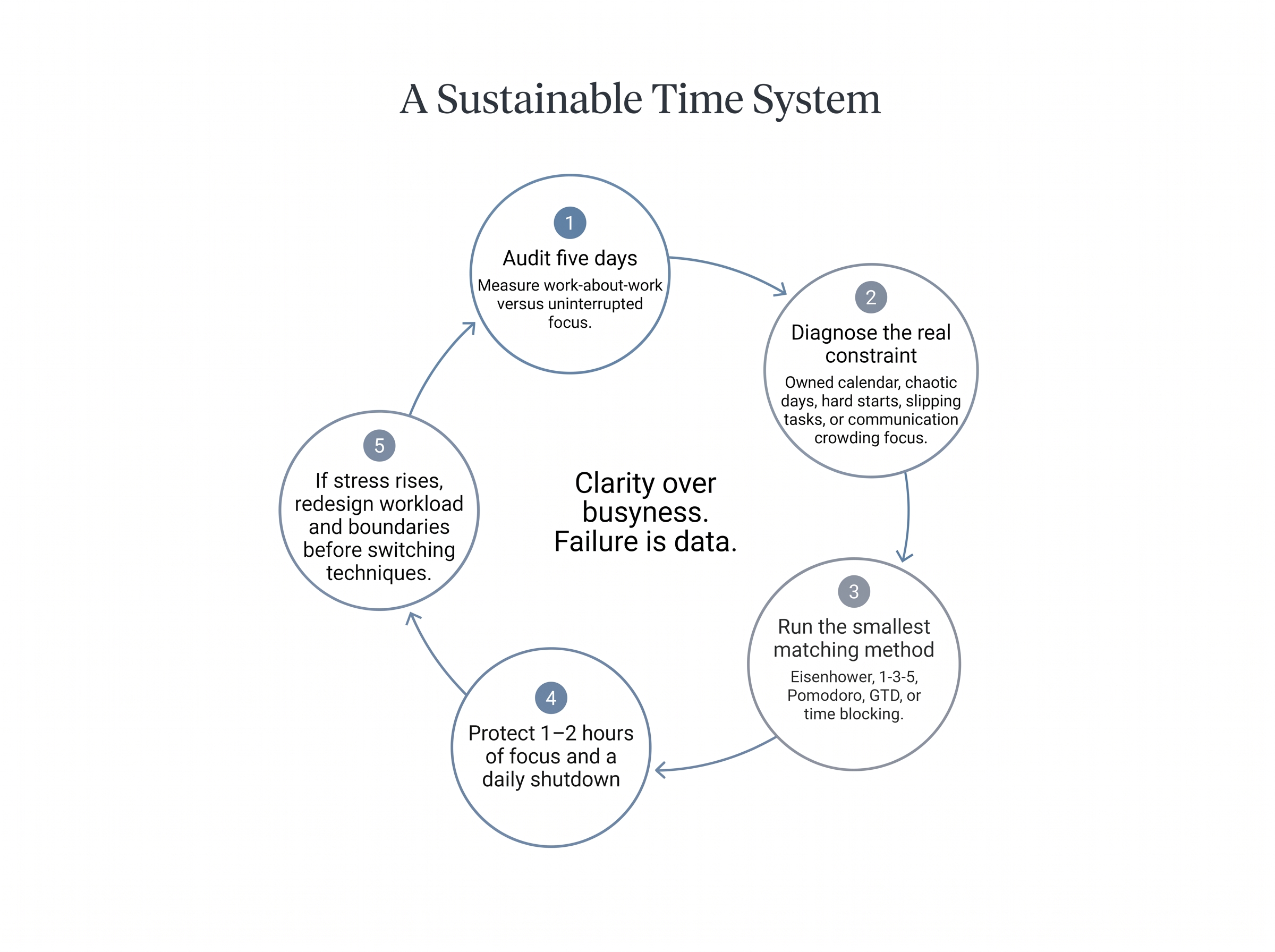
- Run a five-day audit to measure your work about work and how much communication crowds out focused work.
- Pick one method that fits your actual problem.
- Protect one to two hours of focus a day, not an unrealistic eight.
- Close each day with a shutdown routine so work does not keep expanding.
- Treat a failed system as information about your workload or how the system was designed, not as personal weakness.
High performance does not have to cost you your health. That belief sits at the center of everything we publish.
If you want a structured implementation system, build a more organized workday through the Get Organized course. For daily routines, including work, shutdown, morning, and evening structures plus brain breaks and guided breathing, Productivity in Your Pocket is a natural complement.
About the author
Dr. Kara Larson is the author of Workaholic’s Detox.
We’re the Dr. Kara Larson team. We write about what we know best, aiming to explain it clearly and help you decide with information you can trust.
Transparency statement
This article cites peer-reviewed research, practitioner analyses, workplace productivity data, Google Cloud case examples, and LinkedIn discussions. Several workplace statistics come from secondary summaries of Microsoft, Asana, APA, or other research and may not reflect US-only samples. Social media quotes are practitioner perspectives, not independent scientific evidence.
References
[1] How to Reduce Stress at Work | Prevent Burnout
[2] Do time management interventions support wellbeing in the workplace? A systematic review
[3] Real-world gen AI use cases from the world’s leading organizations
[4] Deep Work in an Open Office: Applying Cal Newport’s Rules — A PRAGMATIC MIND
[5] Time block strategy to double your efficiency (and End Overload)
[6] Deep Work Summary: Cal Newport’s 4 Rules
[7] GTD Method: A Complete System for Getting Things Done
[8] Getting Things Done: The GTD method explained – IONOS
[9] Time Management for Coaches: 6 Ways to Reclaim Your Schedule
[10] 10 Proven Time Management Methods & Techniques for Productivity
Responses