

Emotional Resilience: How to Build It at Work

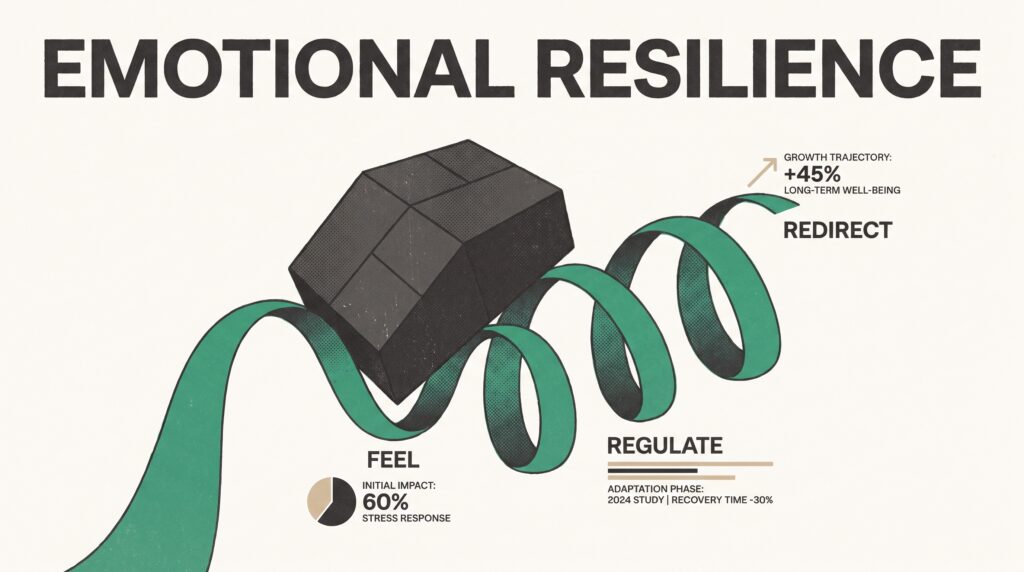
Emotional resilience is the learnable ability to notice difficult emotions, regulate your response, and keep acting in line with what matters. For business owners, managers, and corporate leaders, it does not mean suppressing stress or working through exhaustion. It means recovering after setbacks, deciding clearly under pressure, and adapting to change without sacrificing health, relationships, or personal freedom.
Key takeaways
- Resilience is a trainable process of feeling, regulating, and redirecting — not a fixed trait.
- Short, repeatable practices work better than waiting to become naturally tougher.
- Personal resilience complements organizational change but cannot replace healthy workloads, staffing, or role clarity.
Why Emotional Resilience Matters in the AI Era
AI disruption, customer pressure, staffing shortages, quarterly targets, and a phone that never stops buzzing land on the same desk.
Gallup’s State of the Global Workplace 2025 report found manager engagement fell from 30% to 27% between 2023 and 2024. The 2026 edition, covering 2025, shows a further drop from 27% to 22%.
Emotional resilience is not numbness, toughness, or constant productivity. It is a skill set of awareness, regulation, recovery, and purposeful action. Individual practice cannot replace healthier workloads, adequate staffing, or role clarity. The World Health Organization says organizational change has to come first [8].
What Emotional Resilience Means: Feel, Regulate, and Redirect
A practical definition for leaders under pressure
Emotional resilience is a three-step process: feel a difficult emotion, regulate your immediate response, and choose a constructive next action. The alternative is reacting automatically or suppressing what you feel.
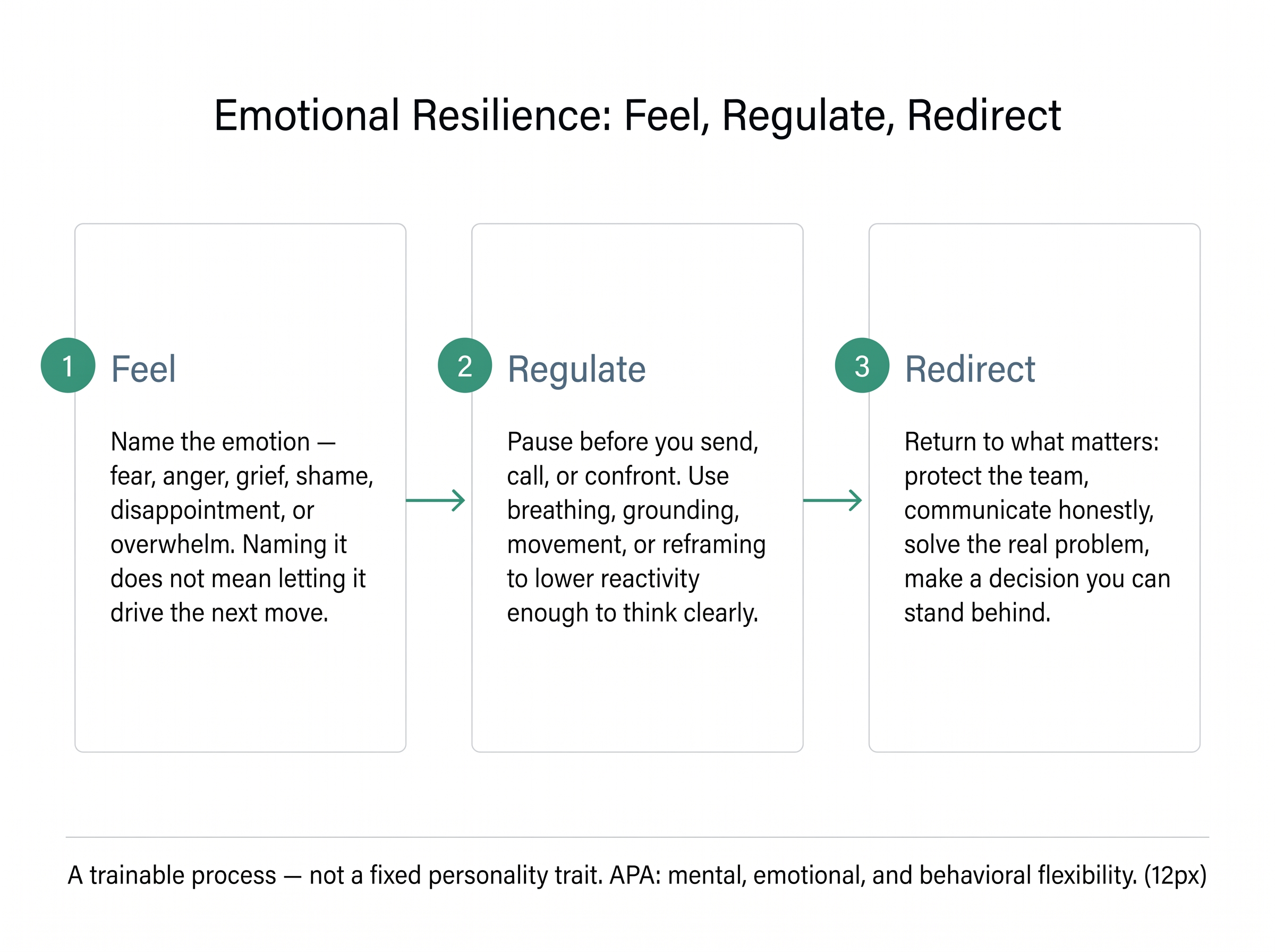
Feel the emotion. Name what is happening: fear, anger, grief, shame, disappointment, overwhelm. Naming it does not mean letting it drive. A leader who can say “I’m angry about this client loss” is less likely to send a regrettable email than one who insists everything is fine.
Regulate the response. Pause before you send the message, make the personnel call, or confront a colleague. Breathing, grounding, movement, or reframing can lower reactivity enough to think clearly.
Redirect toward what matters. Return to the objective: protecting the team, communicating honestly, solving the customer’s problem, making a decision you can stand behind.
The American Psychological Association defines resilience as “the process and outcome of successfully adapting to difficult or challenging life experiences, especially through mental, emotional, and behavioral flexibility” [4]. The APA treats it as a process, not a personality trait: it develops through behaviors, thoughts, relationships, and support, so it can be trained.
Emotional resilience, toughness, suppression, and psychological resilience
| Concept | What it involves | Example in leadership |
|---|---|---|
| Emotional resilience | Feeling, regulating, recovering, acting purposefully | Acknowledging disappointment after a failed launch, learning from it, and communicating next steps |
| Toughness | Enduring discomfort or pressure | Continuing through a difficult quarter |
| Emotional suppression | Hiding or avoiding internal experience | Saying “I’m fine” while becoming irritable, detached, or exhausted |
| Psychological resilience | Broader adaptation across thoughts, behavior, identity, and functioning | Rebuilding confidence and routines after a major disruption |
Resilience is not fixed at birth. Emmy Werner’s Kauai study followed at-risk children for decades and found roughly one-third grew into well-adjusted adults despite serious adversity [3]. That shows people can adapt; it does not show adversity is good for you. Nor does resilience remove grief, fear, or anger — one practitioner resource notes that resilient people feel everything others feel but keep moving toward what matters [1]. The difference is recovery.
Five Evidence-Based Techniques to Build Emotional Resilience
The most useful techniques are short, repeatable practices that help you regulate emotion, recover attention, connect with support, and choose a fitting response. The evidence has limits: a BMJ Open systematic review and meta-analysis found statistically significant effects in only four of eleven resilience interventions reviewed. Experiment, stay consistent, and get professional support when you need it. No technique works for everyone.
| Technique | How to use it | Time cost | Evidence and application |
|---|---|---|---|
| Cognitive restructuring | Write the event, your automatic interpretation, the evidence, an alternative, and your next action | ~5 minutes | Separates facts from catastrophic predictions after a failed presentation, client loss, or conflict |
| Physiological reset | Slow breaths with a longer exhale, or a physiological sigh, then reassess | 60–90 seconds | Useful before answering a charged message; not a cure for chronic stress |
| Mindfulness and attention recovery | Notice thoughts, emotions, and sensations without solving them, then return to the breath | 5–10 minutes | Some industry sources report improvements; treat secondary figures with caution |
| Social buffering | Contact a trusted peer, coach, mentor, or therapist and describe the situation without asking them to fix it | 10–20 minutes | Cohen and Wills’ buffering hypothesis suggests social support may soften stress effects on well-being [2] |
| Micro-recovery and meaning-making | Take screen-free breaks, note what the event is teaching you, and end the day with a written shutdown routine | Seconds to a few minutes | Tests of 20–30-second, 1.5–2-minute, and 5-minute breaks show no consensus on optimal length |
Cognitive restructuring works because it separates what happened from the story you tell about it. Therapists use reframing to build agency: the sense that you control your response even when you cannot control events [10].
Implementation instructions for an overloaded leader
Start with one technique for two weeks rather than trying all five at once. Between meetings:
- Name the emotion.
- Slow your body down.
- Identify the next action you can control.
- Communicate only after the pause.
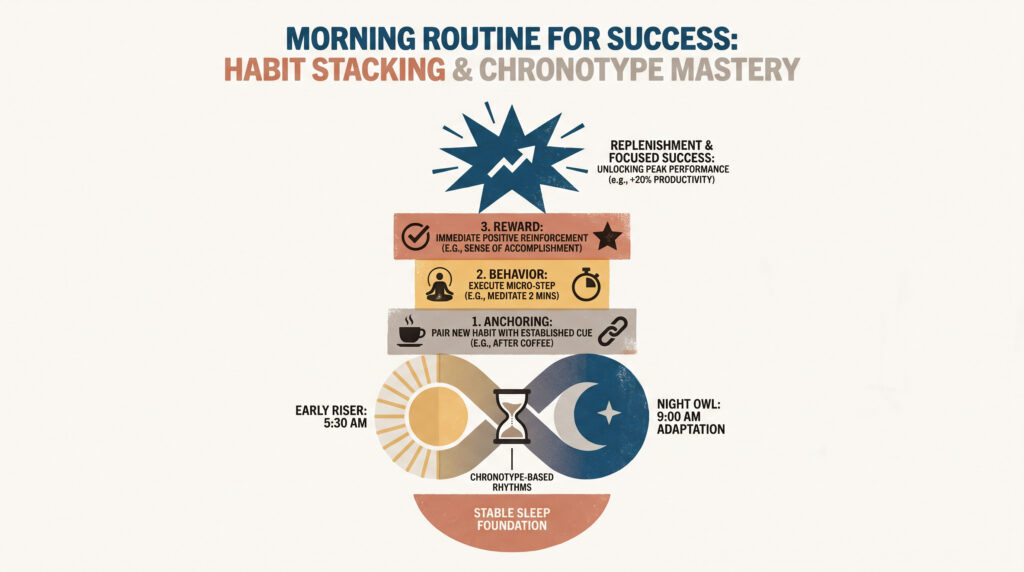
Structured routines help these practices stick. Productivity in Your Pocket teaches work, shutdown, morning, and evening routines, along with brain breaks and guided breathing.
Flexibility matters more than any single tool. Peer-reviewed research in Scientific Reports shows that whether a regulation strategy works depends on context, and the ability to apply strategies flexibly is increasingly recognized as a core mechanism of resilience [5]. A scoping review in Current Psychology adds that effective self-regulation support covers preparation and reflection, not only coping in the moment [6] — meaning you rehearse before a crisis and review afterward.
Emotional Resilience for Leaders: Regulating Yourself Without Excusing the System
Leaders need emotional resilience because their regulation, communication, and recovery habits shape how teams experience uncertainty. Personal resilience should complement organizational change, not replace it.
Why manager resilience affects team performance
Sharpist, a commercial coaching provider, reports that 56% of managers experience burnout and that managers account for 70% of the variance in team engagement. These are industry figures, not population-wide estimates, but they align with Gallup’s direction.
A dysregulated leader communicates with urgency, changes priorities repeatedly, and avoids hard conversations. A regulated leader can acknowledge uncertainty, clarify priorities, and give people room to solve problems. Regulation alone does not determine engagement, but it limits how high engagement can go. If you want individualized support building this capacity, leadership coaching is designed for that work.
A practical leadership protocol during disruption
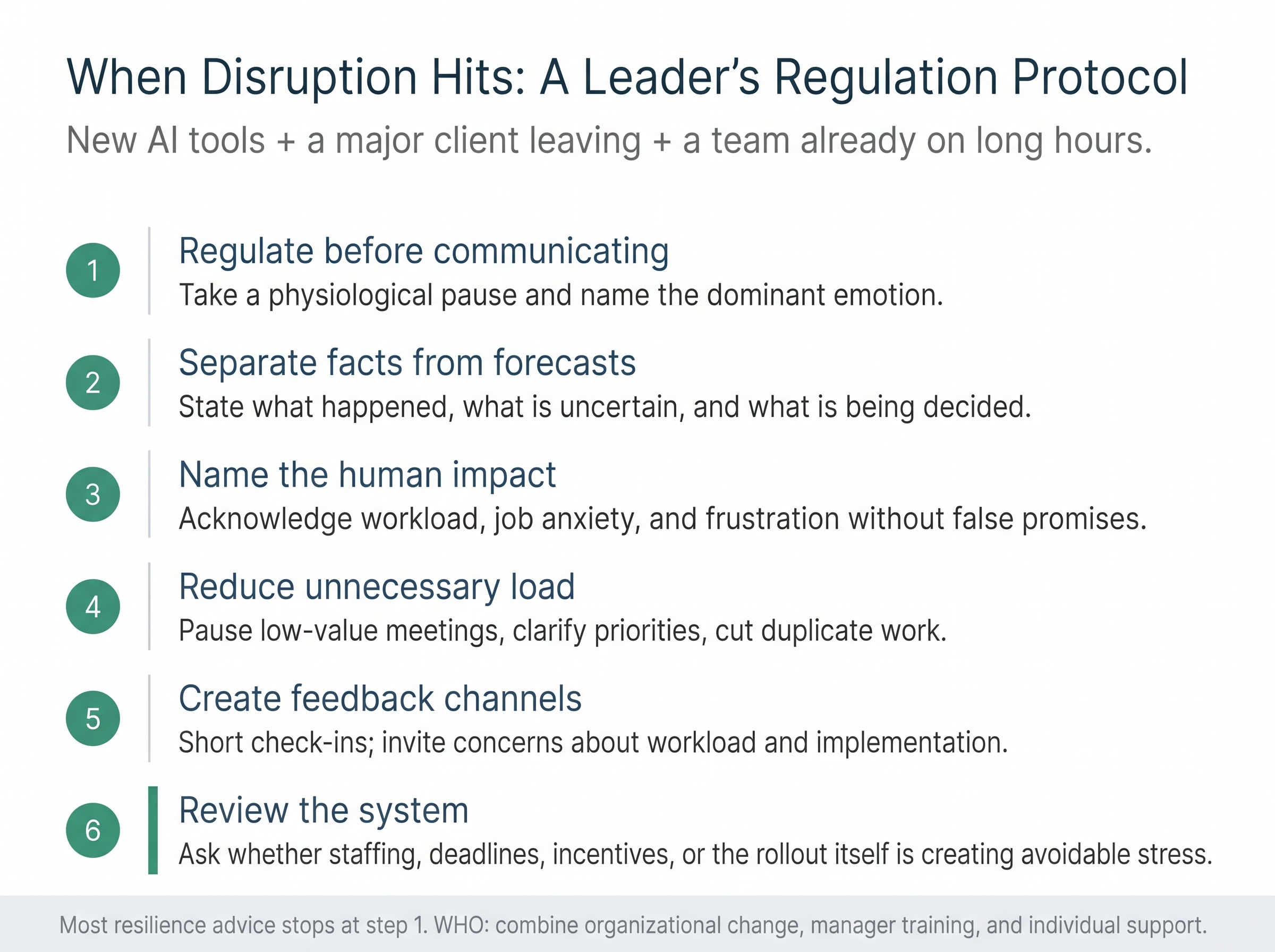
Your company rolls out new AI tools in the same month a major client leaves, and the team is already working long hours. Use these steps:
- Regulate before communicating. Take a brief physiological pause and identify your dominant emotion.
- Separate facts from forecasts. State what happened, what remains uncertain, and what is being decided.
- Name the human impact. Acknowledge workload, job anxiety, and frustration without making promises you cannot keep.
- Reduce unnecessary load. Pause low-value meetings, clarify priorities, eliminate duplicate work.
- Create feedback channels. Hold short check-ins and invite concerns about workload and implementation.
- Review the system. Ask whether staffing, deadlines, incentives, or the rollout itself is creating avoidable stress.
Most resilience content skips the final step. WHO guidance on mental health at work recommends combining organizational interventions, manager training, worker training, and individual support [8]. The World Economic Forum makes a similar point: managers translate organizational strategy into employees’ daily experience, and they need support to do that well [7].
Resilience Versus Pushing Through: Recognizing the Burnout Trap
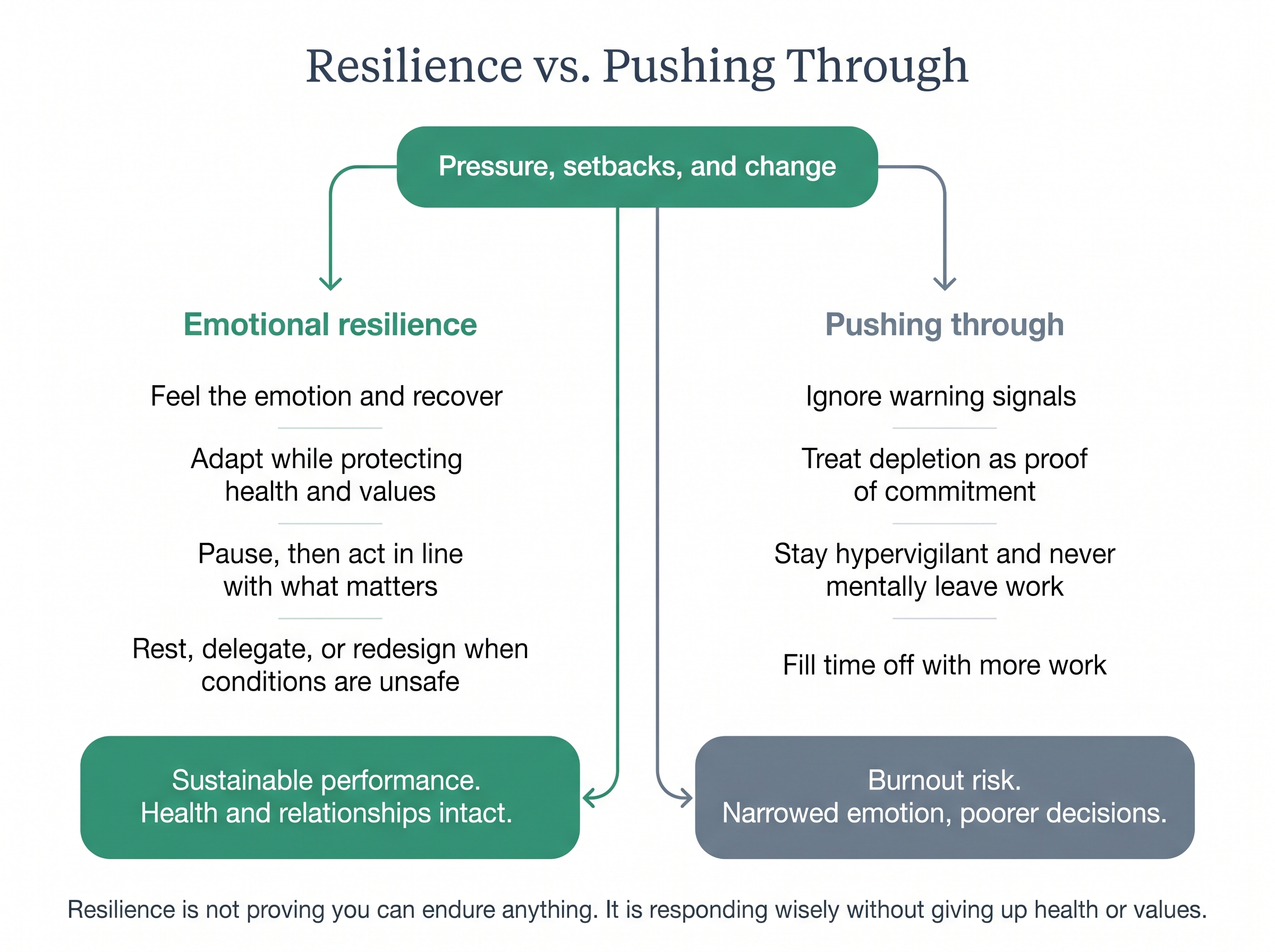
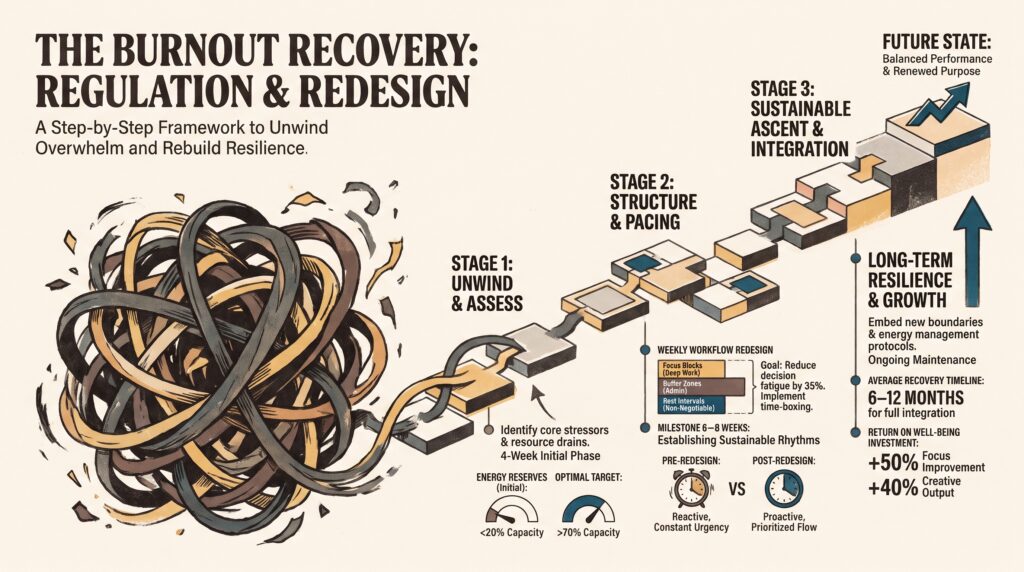
Resilience helps you adapt while protecting your health and values. Pushing through means ignoring warning signals and treating depletion as proof of commitment. Cultures that reward endurance can confuse burnout symptoms with resilience.
Five signs endurance has become a burnout risk
This checklist is not a diagnosis. These signs can also have medical, psychiatric, sleep-related, or situational causes.
- Persistent physical depletion. Sleep does not restore your energy, and routine tasks feel unusually hard.
- Hypervigilance. You stay on alert, check messages compulsively, and cannot mentally leave work.
- Emotional narrowing. Irritability, numbness, cynicism, or loss of pleasure replaces your normal range.
- Reduced executive functioning. Forgetfulness, indecision, trouble concentrating, repeated mistakes.
- Recovery avoidance. Time off makes you feel guilty, and you fill open time with more work.
Clinicians who treat executive burnout assess chronic physical depletion, nervous-system hypervigilance, and the organizational environment together rather than treating it only as individual emotional exhaustion [9].
Being resilient does not mean tolerating unsafe conditions, chronic overwork, harassment, untreated depression, or severe anxiety. Sometimes the resilient choice is to rest, delegate, get a medical evaluation, start therapy, request accommodations, or redesign your workload.
Dr. Kara Larson’s book Workaholic’s Detox focuses on overwork, workaholism, and work-life balance; the free first chapters are available. You can also take the burnout test for self-reflection. It is not a diagnostic instrument.
Limitations, alternatives, and professional guidance
Breathing, mindfulness, reframing, and routines support well-being, but they do not substitute for medical or mental-health care. Consult a qualified professional if you experience persistent distress, trauma symptoms, depression or anxiety, substance use, suicidal thoughts, or significant difficulty functioning day to day. Employers should address workload, role clarity, staffing, manager support, and psychosocial risks directly [8].
Frequently Asked Questions
How can I deal with a crisis in my life or business?
Separate immediate safety from longer-term decisions. Name what happened, regulate before you communicate, take the next action you can control, and contact someone you trust. Avoid irreversible personnel or financial calls while highly activated. Get professional help if distress becomes persistent or disabling.
How can I control my emotions and feelings?
You cannot always control which emotions appear, but you can influence how you respond. Name the emotion, notice its physical signals, pause before acting, and choose a response consistent with your values. Regulation is not suppression.
How can I build mental and emotional resilience?
Use repeated recovery and regulation practices rather than waiting to become naturally tougher. Start with one brief daily practice — reframing, guided breathing, mindfulness, social connection, or a shutdown routine — and track whether recovery, clarity, and behavior under pressure improve.
How does stress affect mental health?
Short-term stress can sharpen attention; chronic or poorly managed stress can affect mood, sleep, concentration, relationships, and physical health. Impact depends on intensity, duration, recovery, support, and circumstances. Coping tools help, but chronic workplace stress also requires changes to workload, control, staffing, or expectations.
What are signs that your body is shutting down from stress?
Warning signs include persistent exhaustion, sleep disruption, headaches, muscle tension, digestive changes, irritability, numbness, concentration problems, and withdrawal. Seek medical or mental-health guidance if they persist, worsen, or interfere with daily life.
What are the most stressful life events for adults?
They vary by person, but common examples include major losses, serious illness, relationship breakdown, financial insecurity, job disruption, caregiving, relocation, and legal or safety crises. How stressful an event feels depends on control, predictability, support, past experience, and time to recover.
Conclusion: Build Resilience Without Making Burnout the Price of Success
Emotional resilience is the ability to feel, regulate, recover, and redirect. Four points matter: it is learnable, as Werner’s Kauai research showed [3]; it is not suppression; it depends on applying techniques flexibly; and it cannot make up for unhealthy systems.
The stakes are higher for leaders, because your regulation shapes communication and communication shapes team climate. With manager engagement at 22%, leaders need recovery, delegation, boundaries, and organizational accountability — not grit alone.
This week: choose one 60–90-second regulation practice, add a five-minute shutdown routine, schedule one supportive conversation, and review after two weeks.
If you want structured practice in emotional regulation and sustainable leadership, explore the Emotional Excellence course.
Resilience does not mean proving you can endure anything. It means building the capacity to respond wisely without giving up your health or your values.
About Dr. Kara Larson
Dr. Kara Larson is the author of Workaholic’s Detox and a leadership coach and AI automation trainer who helps business owners, managers, and corporate leaders improve performance without sacrificing well-being.
We’re the Dr. Kara Larson team, writing to help you decide with information you can trust.
Transparency Statement
This article draws on the American Psychological Association definition of resilience (via the Lyda Hill Institute for Human Resilience at UCCS); the World Health Organization; Gallup’s State of the Global Workplace reports (2025 and 2026); the World Economic Forum; Scientific Reports, BMJ Open, and Current Psychology; research on micro-break duration; industry sources including Sharpist, Hinge Health, City Behavioral Health, Oxford Psychology Clinic, and SimplePractice; and a historical summary of Emmy Werner’s research cited through Wikipedia. Industry sources are labeled as such, and individual practices are not substitutes for medical or mental-health care.
References
[1] Daily Practices for Improving Emotional Resilience
[2] How to Build Emotional Resilience: Proven Tips
[3] Psychological resilience – Wikipedia
[7] 5 steps for CEOs to improve mental health in the workplace | World Economic Forum
[9] Executive burnout treatment: Resilience, recovery, and sustainable leadership | SimplePractice
[10] Therapy for Resilience – Strengthen Your Mind – Sanya Arapovic
Responses